
That sudden, jarring crack. The immediate shock, followed by a wave of panic. We understand. A broken tooth is a distressing and often painful experience, and your first thought might be, ‘Will I lose my tooth?’. Before you do anything else, take a deep, calming breath. You’ve come to the right place for clear, reassuring advice. This is a dental emergency, but it is one that can be managed with skilled, compassionate care.
This guide is designed to empower you in these critical first moments. We will walk you through the immediate steps to take to ease pain and protect your tooth from further damage. You’ll also learn about the different types of dental fractures and discover how a expert can use gentle, advanced treatments to save your natural smile. Our goal is simple: to replace your anxiety with a calm, confident plan of action.
Key Takeaways
- Learn the calm, simple first aid steps to manage pain and protect your tooth in the crucial moments immediately after an injury.
- Understand the difference between a minor chip and a severe fracture to help you know when you need to seek emergency care.
- Ignoring even a small chip in a broken tooth can lead to serious infection; discover the modern, pain-free treatments available to restore your smile.
- For complex breaks or nerve damage, an Endodontist has the advanced training and technology to save teeth that might otherwise be lost.
First Steps: What to Do Immediately After Breaking a Tooth
The shock and sudden pain of a broken tooth can be overwhelming. The most important thing to do is stay as calm as possible and act quickly. While the nature of the injury can vary across different types of tooth fractures, your immediate response in the first 30 minutes can significantly improve the chances of saving your tooth and preventing further complications. The following steps are essential first aid measures to take before you see your emergency dentist.
Collect and Preserve the Tooth Fragment
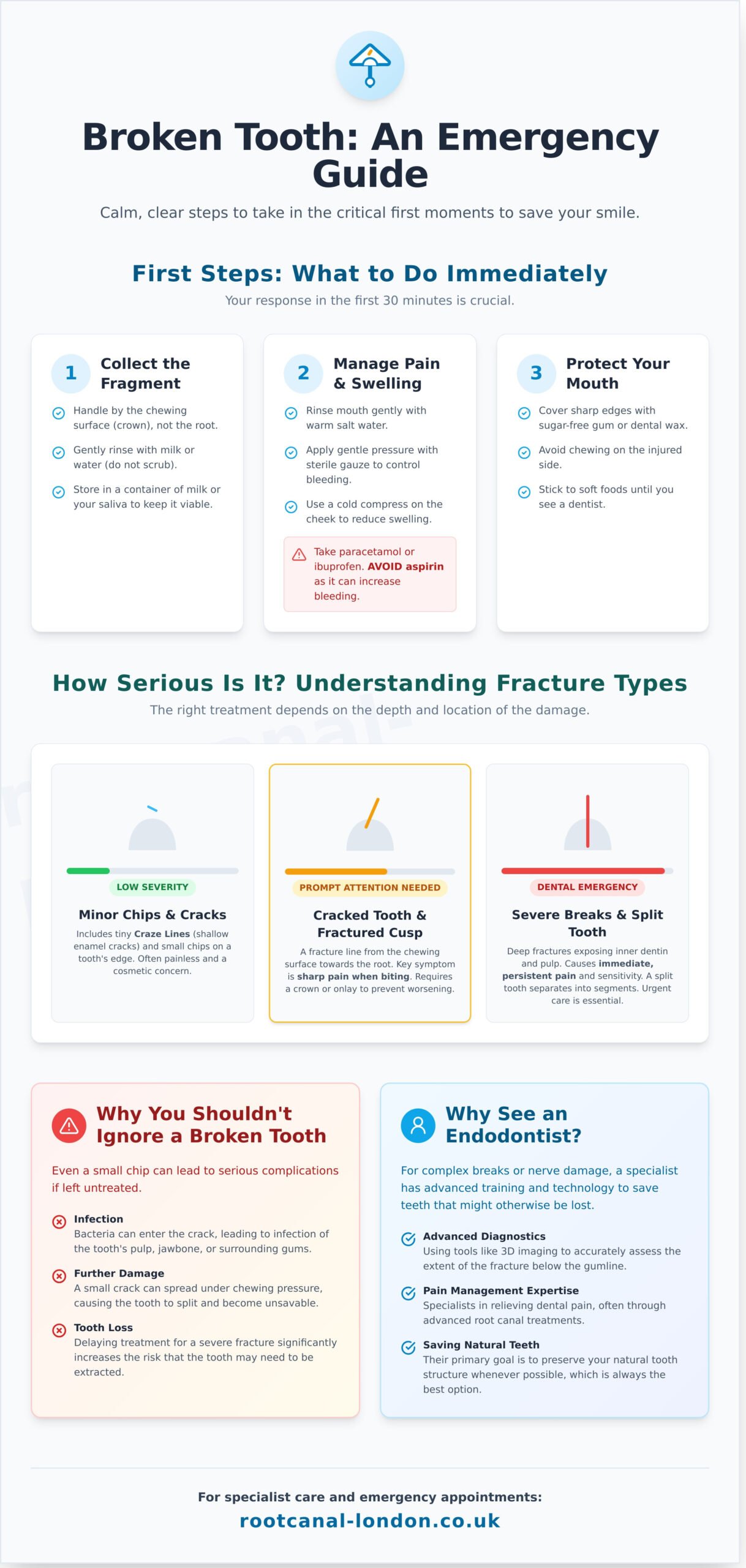
If you can find the piece of your broken tooth, handle it with care. Pick it up by the chewing surface (the crown), not the root end. If it’s dirty, gently rinse it with milk or water for a few seconds-do not scrub it or use any soap. To keep the fragment viable for potential reattachment, place it in a small, clean container filled with milk or your own saliva. This helps preserve the delicate cells on the tooth’s surface.
Manage Pain and Swelling Safely
To provide immediate relief and keep the area clean, follow these simple steps. They are designed to bring comfort and reduce the risk of infection while you arrange dental care.
- Rinse your mouth: Gently swish with a solution of warm water and a half-teaspoon of salt. This helps to clean the area and soothe the gums.
- Control any bleeding: Apply gentle but firm pressure to the area using a piece of sterile gauze or a clean tea bag for 10-15 minutes.
- Reduce swelling: Hold a cold compress or ice pack wrapped in a towel against your cheek or lip over the affected area.
- Pain relief: You can take paracetamol or ibuprofen, but avoid aspirin as it can increase bleeding.
Protect Your Mouth from Sharp Edges
A fractured tooth can leave behind a sharp or jagged edge, posing a risk to your tongue, cheek, and lips. To prevent painful cuts, you can temporarily cover the edge with a piece of sugar-free chewing gum or some dental wax, which is available from most chemists. While you wait for your appointment, avoid chewing on that side of your mouth and stick to soft foods to prevent further damage.
How Serious Is It? Understanding the Types of Tooth Fractures
When you have a broken tooth, the first question is often, “How bad is it?” It’s a worrying experience, but understanding the type of fracture can help you know what to expect and manage your anxiety. Not all breaks are the same, and the right care depends entirely on the location and depth of the damage. Let’s walk through the common types of tooth fractures, from minor chips to more serious breaks, to help you assess your situation.
Minor Chips and Cracks (Craze Lines)
These are the least severe types of fractures and often don’t require urgent care.
- Craze lines are tiny, shallow cracks in the outer enamel. They are very common, often painless, and are typically just a cosmetic concern.
- A minor chip is a small break, usually on the edge of a tooth. It might feel sharp to your tongue but is unlikely to cause pain.
Treatment is often simple and focused on comfort and appearance, such as gentle polishing to smooth a sharp edge or cosmetic bonding to restore the tooth’s shape.
Cracked Tooth and Fractured Cusp
This category requires more prompt attention to prevent the problem from worsening. A cracked tooth involves a fracture line that runs from the chewing surface down towards the root. You might not feel constant pain, but a key symptom is a sharp pain when you bite down or release the pressure. A fractured cusp occurs when a piece of the tooth’s chewing surface breaks off. An endodontic endodontist is often best equipped for saving cracked teeth, as treatment with a filling, onlay, or a protective dental crown is crucial to prevent the crack from spreading.
Severe Breaks and Split Tooth
A severe break is a clear dental emergency. This type of fracture is deep enough to expose the inner layers of your tooth-the dentin and the sensitive pulp tissue inside. This often results in immediate and persistent pain, as well as extreme sensitivity to hot and cold temperatures. A split tooth is the most critical stage, where a crack has propagated through the tooth, separating it into two distinct segments. These are serious injuries that require urgent care, often involving root canal treatment to relieve pain and save what remains of the tooth.
Professional Treatments: How a Dentist Can Fix Your Broken Tooth
Discovering you have a broken tooth can be a distressing experience, but we want to reassure you that modern dentistry offers a wide range of effective and comfortable solutions. The first step in our caring approach is to carefully assess the extent of the damage. From there, we can determine the best treatment to restore your tooth’s health, function, and natural appearance, bringing you lasting relief.
The right treatment path depends entirely on the severity of the fracture. Our goal is always to save your natural tooth whenever possible, using the most conservative treatment that will provide a strong, durable result. Below are the most common professional treatments, from simple repairs to more comprehensive solutions.
Cosmetic Bonding and Dental Fillings
For minor chips or small fractures, especially on your front teeth, cosmetic bonding is an excellent solution. This minimally invasive procedure involves applying a tooth-coloured composite resin directly to the damaged area. Your dentist skilfully shapes and polishes the resin to match your natural tooth, restoring its original shape and appearance seamlessly. This is often completed in a single, pain-free visit, making it a quick and cost-effective way to repair minor damage.
Dental Crowns and Veneers
When a larger piece of the tooth has broken off or the tooth is significantly weakened, a dental crown provides the necessary strength and protection. A crown is a custom-made cap that fits over the entire remaining tooth structure, much like a helmet. For cosmetic damage to the front surface of a tooth, a veneer-a thin shell of porcelain-can be an ideal choice. Both options are crafted to look just like your natural teeth, providing a durable and beautiful restoration.
Root Canal Treatment to Save a Badly Broken Tooth
If a fracture is deep enough to expose the delicate pulp inside your tooth, it can cause severe pain and lead to infection. In these emergency situations, a root canal is not the cause of pain, but the solution to it. The procedure involves gently removing the damaged or infected pulp to relieve your pain and save the tooth from extraction. Understanding the different types of fractures and why expert cracked tooth treatment is so crucial is key. For this precise work, a expert endodontist provides the highest level of skilled, compassionate care to ensure the best possible outcome.
Why You Shouldn’t Ignore a Broken Tooth: The Risks of Waiting
When you have a broken tooth, especially if it doesn’t hurt, it’s tempting to adopt a ‘wait and see’ approach. You might hope it will be fine on its own. However, we want to reassure you that seeking prompt, caring advice is always the safest option. Even a minor chip creates a weakness in your tooth’s structure, leaving it vulnerable to much bigger problems down the line. Acting quickly is not only less expensive but also helps you avoid significant pain and more complex treatments.
The Risk of Infection and Abscess
A crack or break in your tooth enamel is like an open door, inviting bacteria directly into the sensitive inner pulp. This can lead to a painful infection or a dental abscess-a pocket of pus at the tooth’s root. Signs of a developing infection include throbbing pain, swelling in your gums or face, and even a fever. An untreated infection is a serious health risk and can spread to your jaw, neck, and beyond.
Further Damage and Potential Tooth Loss
The daily pressure of chewing can easily turn a small crack into a major fracture. A problem that might have been solved with a simple filling can quickly escalate, requiring a more extensive treatment like a dental crown. If the crack extends below the gum line, the tooth may become unsalvageable. Waiting too long can unfortunately be the difference between saving your natural tooth and needing an extraction.
When to Seek Emergency Care
While any damaged tooth needs professional attention, some situations require immediate, urgent care to relieve pain and save the tooth. Please seek help straight away if you experience:
- Severe or persistent pain that doesn’t subside.
- Visible nerve exposure, which often looks like a small pink or red dot in the centre of the tooth.
- Swelling in the gums, face, or jaw area.
Your comfort and health are our priority. If you’re in pain or concerned about a damaged tooth, please do not wait. Contact Bespoke Dental Fulham for a same-day appointment, and let our compassionate team provide the relief you need.
Why See a endodontist? The Endodontist’s Role in Saving Broken Teeth
When you have a minor chip, your general dentist is often the perfect person to help. However, for a more severe broken tooth, especially one involving deep cracks or nerve damage, seeing a specialised is crucial. An endodontist is a dentist who has completed years of additional, specialised training focused exclusively on diagnosing tooth pain and performing root canal treatment. Their entire practice is dedicated to saving natural teeth, making them the leading experts in handling complex dental trauma with precision and care.
The primary goal is always to save your tooth, and an endodontist has the advanced skills and technology to make that possible, even in the most challenging cases. They provide a level of expertise that ensures the best possible long-term outcome for your dental health.
Advanced Diagnostics and Technology
Endodontists use state-of-the-art equipment to get a complete and accurate picture of the damage. A surgical operating microscope allows them to see tiny, intricate details and hairline cracks that are completely invisible to the naked eye. Paired with advanced 3D imaging like Cone Beam Computed Tomography (CBCT), they can assess the full extent of the trauma to the tooth and surrounding bone. This accurate diagnosis is the foundation for a successful and predictable treatment plan.
Expertise in Pain Management and Complex Cases
We understand that the thought of treatment can be daunting, especially when you are already in pain. Endodontists are highly skilled in profound local anaesthesia, ensuring your experience is as comfortable and pain-free as possible. They are the experts dentists turn to for the most difficult cases, greatly increasing the chances of saving a severely compromised broken tooth. At our practice, Dr. Millie specialises in creating a calm, reassuring environment, providing compassionate care that puts even the most anxious patients at ease.
If you are worried about a damaged tooth and need expert care, please know that help is available. Our specialised team at Bespoke Dental Fulham is here to ease your pain and provide the outstanding treatment you deserve.
Your Path to a Calm and Confident Recovery
A broken tooth is undoubtedly a stressful experience, but the path forward is clear. Remember the key takeaways: act swiftly without panic, understand that professional assessment is non-negotiable to avoid future complications, and know that expert care can save your natural tooth. Taking these steps transforms a dental emergency from a source of anxiety into a manageable problem with a clear solution.
You don’t have to navigate this alone or endure the discomfort. If you’re in pain from a broken tooth, we are here to provide immediate, reassuring care. Book an emergency appointment with our London Expert today.
Led by Specialised Endodontist Dr. Millie, we provide same-day emergency appointments to address your pain right away. Our clinic uses advanced technology to ensure a calm, comfortable, and pain-free experience. Let us restore not only your tooth, but also your peace of mind.
Frequently Asked Questions About a Broken Tooth
Will fixing my broken tooth be painful?
We understand this is a major concern. Our absolute priority is your comfort, and modern dental techniques ensure that fixing a broken tooth is a calm and pain-free experience. We use effective local anaesthetic to completely numb the area before starting any treatment. The goal is to relieve the pain you’re feeling from the damage, not to cause more. You can feel completely at ease in our care.
Can a cracked tooth heal on its own without a dentist?
Unfortunately, no. Unlike bones, teeth do not have the ability to heal or repair themselves once cracked or fractured. Leaving a crack untreated allows bacteria to seep inside, which can lead to infection, decay, and more severe pain. It is essential to see a dentist promptly to assess the damage and provide the right treatment to protect the tooth from further harm and potentially save it from extraction.
How much does it cost to fix a broken tooth in the UK?
The cost to repair a broken tooth in the UK varies depending on the severity and the treatment needed. A simple cosmetic bonding for a small chip can range from £100 to £300. A larger fracture may require a crown, which typically costs between £600 and £1,200. If the nerve is involved, a root canal treatment will be necessary as well. We provide a clear, transparent quote after a thorough examination.
What should I eat if I have a broken tooth?
While you wait for your appointment, stick to soft foods to avoid further damage or pain. Good options include soups, yoghurt, smoothies, scrambled eggs, and mashed vegetables. Try to avoid anything hard, crunchy, or sticky, such as nuts, ice, or toffee. It’s also wise to chew on the opposite side of your mouth and avoid foods or drinks that are extremely hot or cold if the tooth feels sensitive.
How can I tell if the nerve in my broken tooth is damaged?
A key sign of nerve damage in a broken tooth is severe, constant, or throbbing pain. You might also experience extreme, lingering sensitivity to hot or cold temperatures long after the food or drink is gone. Other indicators include the tooth changing colour-often turning grey or dark-or swelling and tenderness in the gum area around the tooth. If you notice any of these symptoms, it is crucial to seek immediate dental advice.
Is a broken tooth always a dental emergency?
While any broken tooth needs professional attention, it’s not always a critical emergency. If you are experiencing severe pain, significant bleeding, or have lost a large piece of the tooth, you should seek emergency care immediately. A minor, painless chip is less urgent but still requires a dental visit to prevent sharp edges from cutting your mouth and to stop decay from setting in. It is always best to call for a professional assessment.