

That deep, throbbing ache radiating from the back of your jaw is unmistakable. It’s the kind of discomfort that disrupts your sleep, makes every meal a challenge, and can fill your day with anxiety. When you’re dealing with severe wisdom teeth pain, it’s easy to feel overwhelmed and unsure of what to do next. You’re not just looking for a solution; you’re looking for immediate relief and the peace of mind that comes with understanding what’s happening inside your mouth.
We are here to provide that calm and clarity. This reassuring guide is designed to empower you with the knowledge you need. We will gently walk you through the common causes of your discomfort, share safe and effective ways to find relief at home right now, and clearly explain the signs that mean it’s time to seek compassionate, professional care. Our goal is to ease your worries, answer your questions, and help you take the next step towards lasting comfort with confidence.
Why Do My Wisdom Teeth Hurt? Common Causes Explained
If you’re experiencing a dull ache or sharp pain at the back of your mouth, you are not alone. This discomfort is often the first sign of an issue with your third molars. To understand the problem, it helps to know what wisdom teeth are: they are the last set of molars to emerge, usually in our late teens or early twenties. For many people, the modern jaw simply doesn’t have enough room to accommodate them. This lack of space is the primary reason why so many of us experience wisdom teeth pain. Think of this pain not as something to fear, but as your body’s way of signalling that it’s time to seek professional care.
Here are the most common reasons your wisdom teeth may be causing you discomfort, explained in a clear and reassuring way.
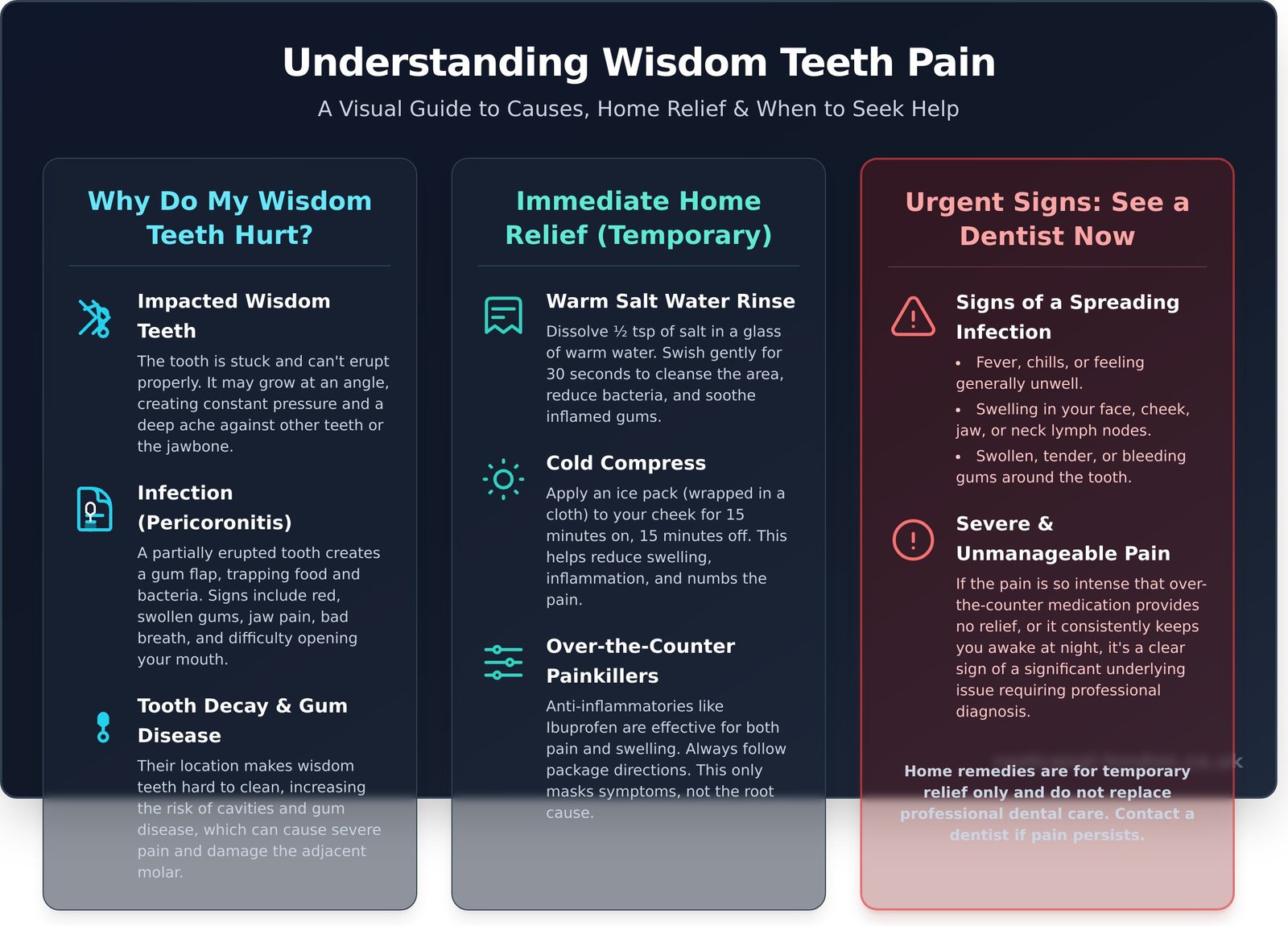
Impacted Wisdom Teeth
One of the most frequent causes of pain is an ‘impacted’ wisdom tooth. This simply means the tooth is stuck and cannot fully break through the gum line into its proper position. It might be growing at an angle towards the next tooth, towards the back of the mouth, or even lying horizontally within the jawbone. This constant pressure against your other teeth or the jaw can create a persistent, deep ache and a feeling of discomfort.
Infection and Swelling (Pericoronitis)
When a wisdom tooth only partially erupts, it can create a small flap of gum tissue around it. Unfortunately, this flap can easily trap food particles and bacteria, creating the perfect environment for an infection known as pericoronitis. This is a very common source of acute pain and discomfort. Key signs include:
- Red, swollen, and tender gums around the back tooth
- Jaw pain or stiffness
- An unpleasant taste or bad breath
- Difficulty opening your mouth comfortably
Tooth Decay and Gum Disease
Their position at the very back of your mouth makes wisdom teeth notoriously difficult to clean effectively with a toothbrush and floss. This difficulty significantly increases their risk of developing tooth decay (cavities) and gum disease. A cavity can quickly deepen, leading to severe pain if it reaches the tooth’s inner pulp. Furthermore, inflammation or decay around a wisdom tooth can also compromise the health of the vital molar right next to it.
Immediate Wisdom Tooth Pain Relief: What You Can Do at Home Right Now
We understand how debilitating and disruptive wisdom teeth pain can be. When a dull ache escalates into a sharp, persistent pain, it can affect everything from eating to sleeping. The following steps are designed to provide you with some immediate, temporary comfort while you arrange a professional dental consultation. This discomfort is your body’s way of signalling a problem, often related to the common symptoms of impacted wisdom teeth, which requires expert attention.
Important: These home remedies are for short-term pain management only. They do not address the underlying cause of the pain and are not a substitute for a proper diagnosis from your dentist. Even if the pain subsides, it is crucial to have the area examined to prevent more serious complications.
Gentle Oral Hygiene and Rinses
Keeping the area clean is a vital first step to reduce irritation. A warm salt water rinse is a simple, effective way to soothe inflamed gums and cleanse the area. Simply dissolve half a teaspoon of salt in a glass of warm (not hot) water and swish it gently around your mouth for 30 seconds before spitting it out. This can help reduce bacteria and remove trapped food particles. When brushing, use a soft-bristled toothbrush and be exceptionally gentle around the sore tooth to avoid causing more pain.
Managing Swelling and Discomfort
Swelling often accompanies wisdom tooth pain. To manage this, apply a cold compress or an ice pack wrapped in a tea towel to the outside of your cheek. The cold helps to constrict blood vessels, which can reduce inflammation and numb the area, providing welcome relief. For your safety, follow the 15-minutes-on, 15-minutes-off rule. Applying cold for longer periods can potentially damage your skin, so be sure to give your skin a rest between applications.
Over-the-Counter Pain Medication
For more persistent pain, over-the-counter anti-inflammatory painkillers can be very effective. Medications like ibuprofen (found in products like Nurofen in the UK) are often recommended because they target both the pain and the inflammation causing it. Paracetamol is another option if you cannot take anti-inflammatories. Always read the label and follow the dosage instructions on the package carefully. Remember, this medication only masks the symptoms; it does not solve the root cause of your wisdom teeth pain.
When Home Remedies Aren’t Enough: Urgent Signs to See a Dentist
While home care can provide temporary relief for mild discomfort, it’s crucial to recognise when your body is sending a more serious signal. Ignoring these signs can lead to more complex problems that require urgent attention. If your wisdom teeth pain is accompanied by any of the following symptoms, it’s time to seek professional, caring help.
Signs of a Spreading Infection
An impacted wisdom tooth can create a pocket where bacteria thrive, leading to an infection (pericoronitis). If left untreated, this can spread. We want you to feel safe and cared for, so please look out for these warning signs:
- A fever, chills, or generally feeling unwell and fatigued.
- Noticeable swelling in your face, cheek, jaw, or the lymph nodes under your jawline.
- Swollen, tender, or bleeding gums around the wisdom tooth.
These symptoms indicate the infection may no longer be localised to your tooth and could be affecting your entire system. Prompt professional care is essential to stop it from spreading.
Severe and Unmanageable Pain
Pain is your body’s alarm system, and severe pain demands immediate attention. Over-the-counter painkillers should provide some relief; if they don’t make a difference, it’s a red flag. This level of pain often points to a significant underlying issue. As institutions like the Mayo Clinic explain, the causes of impacted wisdom teeth can lead to complications like cysts or damage to adjacent teeth, which require expert diagnosis.
You should seek emergency care if the pain is so intense that it keeps you awake at night or prevents you from going about your day. If you experience any difficulty breathing or swallowing, this is a medical emergency and you should seek help immediately.
Functional Difficulties
Beyond pain, pay close attention to how your mouth is functioning. These signs often point to a worsening infection or severe inflammation that needs a professional assessment:
- Trouble opening your mouth fully (Trismus): This indicates that swelling and inflammation are affecting your jaw muscles.
- A persistent bad taste or smell: This can be caused by pus draining from an infected area around the tooth.
Your health and comfort are our highest priorities. If you are experiencing any of these urgent symptoms, please do not wait. Call our emergency line immediately for compassionate, expert advice and care.
Professional Diagnosis and Treatment: It’s Not Always Extraction
We understand that the thought of a dental visit, especially when you’re in pain, can be a source of anxiety. At our practice, your comfort is our first priority. A modern dental assessment is a calm, reassuring process designed to do one thing: find the true source of your discomfort so we can provide lasting relief. The goal is not to rush to an extraction, but to give you a precise diagnosis and a clear, gentle treatment plan.
Getting an Accurate Diagnosis
To understand what’s causing your wisdom teeth pain, we need a clear picture of what’s happening below the gumline. Our caring diagnostic process involves:
- A Gentle Visual Examination: We’ll look for signs of swelling, redness, or visible decay.
- Digital X-rays: These images allow us to see the position of your wisdom tooth, check for impaction, and assess the health of the bone and surrounding teeth.
- Advanced 3D CBCT Scans: For complex cases, a Cone Beam CT scan provides an incredibly detailed, three-dimensional view. This helps us see nerve pathways and identify hidden infections with pinpoint accuracy.
Crucially, this imaging allows us to check the health of the adjacent second molar, which can often be the real source of the problem.
Conservative Treatment Options
If the issue is a mild gum infection (pericoronitis) caused by a partially erupted tooth, surgery may not be necessary. Often, the pain can be resolved with more conservative steps. This could involve a deep professional cleaning around the area to remove trapped food and bacteria, followed by a course of antibiotics to clear the active infection. For many patients, these simple, gentle measures are enough to bring complete relief.
Is it Your Wisdom Tooth or the Next One Along?
Sometimes, the pain you feel in your jaw is not coming from the wisdom tooth itself. An impacted wisdom tooth can push against the neighbouring second molar, creating a space that is impossible to clean. This can lead to severe decay and infection deep inside the nerve of that second molar, a condition that requires a root canal to resolve.
This is a classic case of referred pain, and it’s why an expert diagnosis is so vital. As specialists in complex tooth pain, we are skilled at identifying the precise cause of your discomfort. If the problem lies with the second molar, a caring and precise root canal treatment can save the tooth and eliminate the pain, avoiding the need for any wisdom tooth surgery at all.
Navigating Your Dental Emergency: Our Gentle Approach in London
We understand that dental pain can be a frightening and overwhelming experience. The thought of an emergency visit often adds to that anxiety, especially when dealing with intense wisdom teeth pain. That’s why we have designed every step of our process at Root Canal London to be as calm, gentle, and reassuring as possible. Your comfort and peace of mind are our highest priorities from the moment you get in touch.
Your First Call to Us
When you call our London clinic, you will speak to a compassionate and understanding member of our team. Their first job is to listen. We will gently ask a few simple questions to assess the urgency of your situation:
- Where is the pain located and how severe is it?
- Are you experiencing any swelling in your face or jaw?
- Have you had a fever or difficulty opening your mouth?
This information helps us prepare for your visit. Our promise to you is that we will do everything we can to see you on the same day and bring you relief as quickly as possible.
The Emergency Consultation
Your appointment is a dedicated time for you. It begins with a calm conversation where you can explain your symptoms and concerns without feeling rushed. Our specialist will then perform a gentle, thorough examination. To get a precise diagnosis, we may use our state-of-the-art, low-radiation digital X-rays, which are quick and entirely painless. Once we understand the root cause of your discomfort, we will explain everything clearly, showing you the X-rays and discussing all your treatment options. There is never any pressure; our role is to empower you with information.
Our Commitment to Pain-Free Care
The fear of pain during treatment is a major source of anxiety, and we are committed to eliminating it. We use modern, effective local anaesthesia to ensure you are completely numb and comfortable before any procedure begins. Our specialist is renowned for a wonderfully calming and reassuring manner, which helps even the most nervous patients feel safe and relaxed. Our ultimate goal is to not only resolve your immediate wisdom teeth pain but to do so in a way that rebuilds your confidence in dental care. We are here to help you get out of pain and protect your oral health for the future. You can learn more about our gentle approach at rootcanal-london.co.uk.
Your Path to Lasting Dental Comfort
Navigating persistent wisdom teeth pain can be daunting, but you now have the knowledge to manage discomfort at home and recognise when it’s time to seek professional help. Remember that while home remedies can offer temporary relief, understanding the warning signs is crucial for your long-term oral health. A timely diagnosis doesn’t always lead to extraction; it leads to the right treatment for you, delivered with care and precision.
You don’t have to endure this pain alone. At our specialist Endodontist-led clinic in London, we are dedicated to providing a calm and reassuring patient experience. We understand the urgency of your situation, which is why we offer same-day emergency appointments to address your pain promptly and professionally.
In Pain? Call Our Emergency Line for a Same-Day Appointment
Taking this step is the start of finding lasting comfort and reclaiming your well-being. We are here to help you smile without pain again.
Frequently Asked Questions About Wisdom Teeth Pain
How long does wisdom tooth pain usually last if left untreated?
Untreated wisdom tooth pain can last indefinitely. It often comes in cycles, flaring up for several days before subsiding, only to return weeks or months later. The underlying issue, such as an impacted tooth or a recurring infection, will not resolve on its own. Ignoring the pain can lead to more severe problems, so we always recommend a professional assessment to find a permanent, pain-free solution and restore your comfort.
Can wisdom tooth pain come and go in waves?
Yes, it is very common for this discomfort to be intermittent. You might experience a few days of sharp pain and swelling, followed by a period where it feels much better. This usually happens when a flare-up of inflammation or a minor infection temporarily calms down. However, these waves of pain are a clear sign that an underlying problem exists, and a dental evaluation is needed for lasting relief.
Will antibiotics alone permanently fix my wisdom tooth pain?
While antibiotics are highly effective for treating an active infection and can provide significant temporary relief, they do not fix the root cause. The physical issue, such as an impacted tooth or a gum flap that traps food, will remain after your course is finished. This means the infection and the wisdom teeth pain will likely return. Antibiotics are a vital first step, but a dental assessment is essential for a permanent solution.
Is it a dental emergency if my wisdom tooth is bleeding slightly?
Slight bleeding from the gum around a wisdom tooth, especially after brushing, is usually a sign of inflammation (gingivitis) rather than a dental emergency. You can manage this by rinsing gently with warm salt water. However, if the bleeding is heavy, continuous, or accompanied by severe pain, facial swelling, or fever, you should seek emergency dental care immediately. We are here to provide calm, reassuring advice if you are unsure.
What’s the difference between wisdom tooth pain and a regular molar toothache?
The key difference is often the location and type of symptoms. Wisdom tooth pain is felt at the very back of the jaw and frequently radiates towards the ear or neck. It is often accompanied by jaw stiffness, swollen gums, or difficulty opening your mouth. A typical molar toothache is more localised to one tooth and is more commonly triggered by sensitivity to hot, cold, or sweet foods rather than pressure from eruption.
Do I need a specialist to look at my wisdom tooth pain?
Your general dentist is the best person to see first. They can perform a thorough examination, take X-rays, and diagnose the cause of your discomfort. In many cases, they can provide the necessary treatment themselves. If your situation is more complex-for instance, if the tooth is deeply impacted or positioned near a nerve-they will refer you to a trusted specialist, like an oral surgeon, to ensure a safe and comfortable experience.