
Dealing with severe tooth pain is stressful enough. When your dentist mentions a ‘root canal,’ a new wave of questions and anxieties can arise. You might wonder if your dentist is the right person for the job or if you need a specialist, known as an endodontist. This uncertainty, coupled with the fear of a painful procedure, can feel overwhelming when all you want is relief.
An endodontist is a highly-trained expert dedicated exclusively to saving natural teeth through advanced root canal therapy. Their focused experience, specialised equipment, and gentle techniques are designed to make your treatment as comfortable, painless, and successful as possible. They are the specialists you turn to for the highest standard of care to relieve your pain and protect your smile for years to come.
In this guide, we will explore the crucial differences between a general dentist and an endodontist. Our goal is to empower you with the knowledge to make a confident decision, ensuring you can save your tooth and find lasting, comfortable relief.
Key Takeaways
- Learn why a root canal specialist, known as an endodontist, has advanced training and experience focused exclusively on saving your natural teeth.
- Recognise the critical differences in experience and technology that directly impact the comfort and long-term success of your root canal treatment.
- Use our simple guide to determine if your specific symptoms, such as severe pain or a previous treatment, mean you need a specialist’s care.
- Ease your anxiety by understanding the calm, step-by-step process of a modern root canal, designed entirely for your comfort and relief.
What is an Endodontist? The Specialist in Saving Teeth
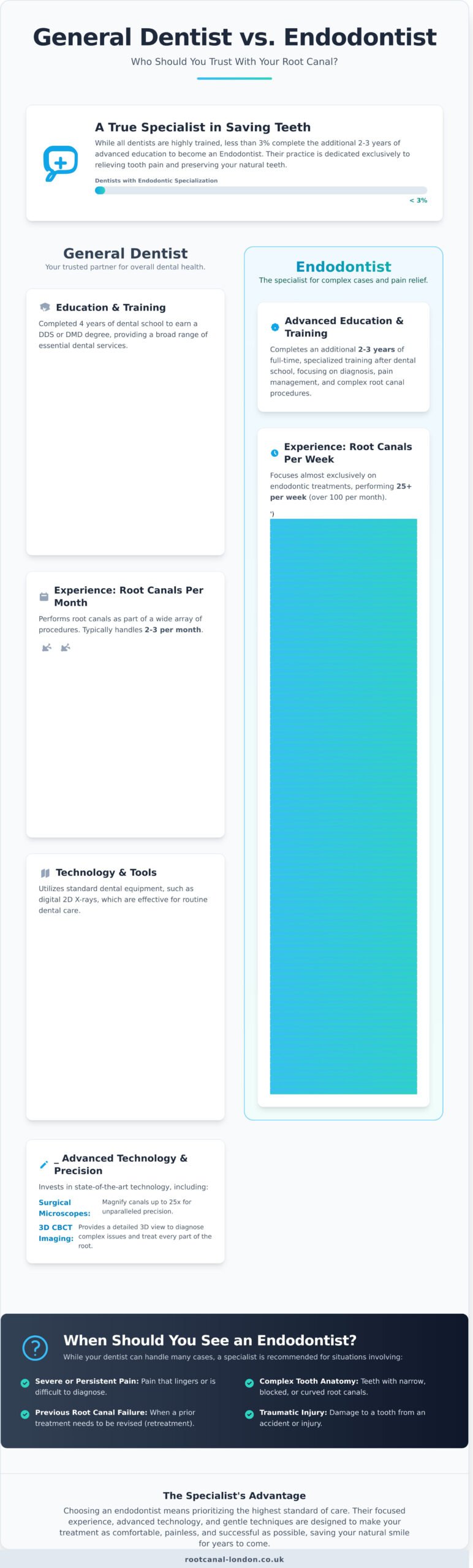
When you have a serious heart condition, you see a cardiologist, not your GP. The same principle applies to complex tooth problems. An endodontist is a highly skilled dental specialist who focuses exclusively on diagnosing tooth pain and treating issues inside the tooth. While all dentists are trained to care for your teeth, less than 3% complete the advanced training required to become a specialist in this field. Their primary mission is singular and vital: to save your natural teeth from extraction and provide lasting relief from pain.
Their expertise is centred on the tooth’s delicate interior-the pulp, which contains nerves, blood vessels, and connective tissue. This specialisation, known as Endodontics, equips them with the unique skills and technology needed to handle the most intricate cases with precision and care, ensuring a calm and reassuring experience for you.
Advanced Education and Rigorous Training
After completing dental school, an aspiring endodontist undertakes an additional two to three years of intensive, full-time training in a postgraduate university programme. This rigorous education is dedicated solely to understanding the complex causes of tooth pain and mastering advanced procedures to treat it. Their training covers:
- Complex Diagnosis: Accurately identifying the source of pain, even in the most difficult cases.
- Advanced Procedures: Mastering root canal therapy, root canal retreatment, and surgical endodontics.
- Pain Management: Utilising sophisticated anaesthesiology techniques to ensure your treatment is as comfortable and pain-free as possible.
A Day in the Life: A Practice Limited to Endodontics
A general dentist provides a wide range of essential services, from fillings and cleanings to crowns and cosmetic work. In contrast, an endodontist’s practice is entirely focused on preserving teeth through pulp therapy. On any given day, they will perform multiple root canal treatments, while a general dentist might only perform a few in a month. This high volume builds an unmatched level of experience and precision. By dedicating every day to these complex procedures, they develop a refined skill set that leads to more predictable, successful, and comfortable outcomes for patients.
General Dentist vs. Endodontist: 4 Critical Differences for Your Treatment
When you’re experiencing severe tooth pain, you want relief from a trusted expert. While your general dentist is your go-to for routine care, a root canal is a highly complex procedure. The choice between a generalist and a specialist often comes down to three things: focused experience, advanced technology, and the highest possible chance of a successful, long-term outcome. Understanding these differences is the first step toward a calm and comfortable treatment experience.
| Feature | General Dentist | Endodontist |
|---|---|---|
| Typical Caseload | 2-3 root canals per month | 25+ root canals per week |
| Technology | Standard dental X-rays | Surgical microscopes & 3D CBCT imaging |
| Focus | Broad range of dental care | Specialised in saving natural teeth |
| Success Rate | Good for straightforward cases | Significantly higher, especially for complex cases |
Experience and Diagnosis Accuracy
An endodontist is a dentist who has completed several years of additional, specialised training focused exclusively on diagnosing tooth pain and performing root canal treatment. Where a general dentist may perform two or three root canals a month, an endodontist performs an average of 25 per week. This incredible depth of experience allows them to accurately diagnose complex or unusual cases, finding the true source of your pain when other signs are unclear.
Specialised Technology for Precision
To effectively treat the intricate network of canals inside a tooth, you need to see it clearly. Endodontists use technology rarely found in general dental practices, including surgical operating microscopes to magnify the tiny canals up to 25 times. They also utilise 3D Cone Beam Computed Tomography (CBCT) imaging, which provides a detailed, three-dimensional view of your tooth’s anatomy. This precision ensures every part of the root canal system is thoroughly cleaned, leading to a much higher rate of success.
Expertise in Pain Management
We understand that the biggest fear surrounding root canals is pain. However, modern techniques have made the procedure a comfortable and pain-free experience. As specialists in this specific treatment, endodontists are masters of profound numbing techniques to ensure you feel nothing during the procedure. Their skill and efficiency also mean your treatment is often completed more quickly, helping to minimise anxiety and manage any post-procedure discomfort effectively.
Higher Success Rate and Complex Cases
Ultimately, the goal is to save your natural tooth for a lifetime. The combination of specialised training, vast experience, and advanced technology gives a specialist endodontist a significantly higher long-term success rate. They are uniquely equipped to handle challenges like unusually curved canals, blockages, or narrow roots. This expertise is also a key reason why you should see an endodontist for retreating a previously failed root canal. Choosing a specialist from the start can provide peace of mind and prevent the need for future treatment.
When Do You Absolutely Need to See an Endodontist?
If your general dentist has recommended you see a specialist, it’s a positive sign. It means they are committed to ensuring you receive the most precise and effective care for your specific situation. Seeing an endodontist isn’t a last resort; it’s a proactive step towards saving your natural tooth with the highest chance of success and providing you with a calm, comfortable experience.
An endodontist is a dentist who has completed years of additional training focused exclusively on diagnosing tooth pain and performing root canal treatment. As the American Association of Endodontists highlights, this advanced education prepares them to handle difficult procedures with greater precision, using specialised technology to ensure the best possible outcome.
Common Symptoms That Warrant a Specialist Visit
While your dentist is your first port of call, certain symptoms strongly suggest a specialist’s touch is needed for your comfort and a successful outcome. Consider this your self-assessment checklist:
- Lingering Pain: Your tooth hurts for more than 30 seconds after being exposed to hot or cold temperatures. This indicates deep inflammation that requires expert attention.
- Severe, Spontaneous Pain: You experience a severe, throbbing toothache that comes on without any trigger, especially if it wakes you up at night.
- Noticeable Swelling: You have swelling in the gum area near the painful tooth, or visible swelling on your cheek or face.
- Discolouration or Gum Bumps: Your tooth has turned a greyish colour, or you’ve noticed a small, pimple-like bump (a fistula) on your gum line nearby.
Specific Scenarios Requiring an Endodontist
Beyond symptoms, some dental situations are inherently more complex and benefit from the focused expertise of a root canal specialist. These include:
- Treatment on a Molar: Your back teeth (molars) have multiple, often narrow and curved, root canals, making them technically challenging to treat thoroughly.
- Previous Root Canal Failure: If a tooth that has already had a root canal becomes reinfected or painful, a specialist is needed for complex retreatment.
- Traumatic Tooth Injury: A cracked or fractured tooth requires careful diagnosis and specialised care to determine if it can be saved.
- Complex Diagnosis: Sometimes, the source of dental pain is not obvious. An endodontist uses advanced diagnostic tools, like CBCT 3D imaging, to pinpoint the exact cause.
Your Endodontic Visit: A Calm and Reassuring Process
We understand that the thought of a root canal can cause anxiety. That’s why we’ve designed every step of your journey with us to be as calm, comfortable, and clear as possible. When you are in the hands of a specialist, the process is far from the myths you may have heard. It’s a gentle, precise procedure focused on one thing: relieving your pain and saving your natural tooth.
Step 1: The Specialist Consultation and Diagnosis
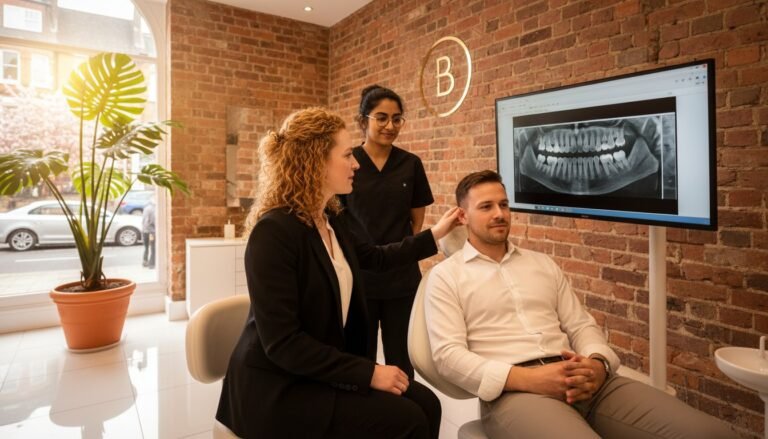
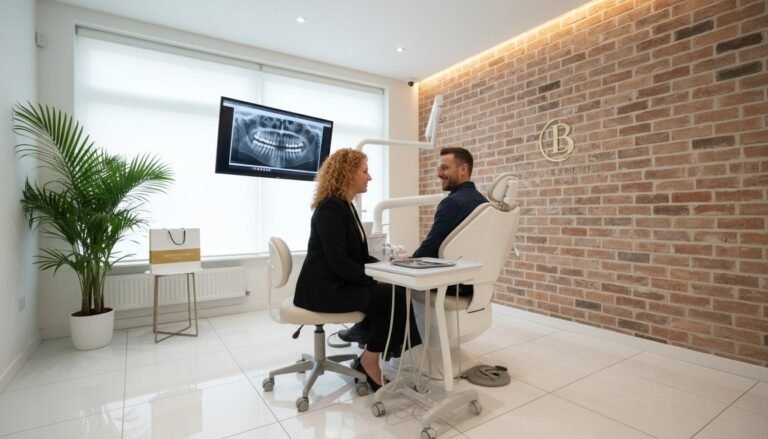
Your journey to relief begins with a conversation. We’ll listen carefully to your concerns before conducting a thorough and gentle examination of the painful tooth. To get a crystal-clear picture of the root issue, we often use advanced 3D imaging (a CBCT scan). This allows your endodontist to diagnose the problem with incredible accuracy. We then take the time to explain our findings, show you the images, and discuss your treatment options in simple, easy-to-understand terms. This is your time to ask questions and feel completely confident in the plan we create together.
Step 2: The Treatment – Focused on Your Comfort
Our first priority is ensuring your treatment is a completely pain-free experience. We take great care to profoundly numb the area before we begin, and we won’t proceed until you are comfortable. Working with a high-powered surgical microscope, we can see the intricate details inside your tooth, allowing for unmatched precision. This specialist approach not only leads to better outcomes but also makes the entire process efficient and smooth, often completed in just one or two visits. Our compassionate team will be by your side, ensuring you feel safe and cared for throughout.
Step 3: Aftercare and Saving Your Tooth
Once your treatment is complete, our care continues. We provide clear, simple instructions on how to look after your tooth at home and manage any mild, temporary discomfort. We then communicate directly with your general dentist, sharing all the details of your successful treatment. Your dentist will typically place a permanent crown to protect the tooth for the long term. Follow-up appointments are scheduled to monitor your healing, giving you peace of mind that your tooth is recovering perfectly and is ready to serve you for years to come.
Why Choose Bespoke Dental Fulham for Your Endodontic Care
Understanding why a specialist is crucial for your root canal is the first step. The next is finding a practice that combines world-class expertise with genuine, patient-focused care. At Bespoke Dental Fulham, we are dedicated to being that place for you. We provide outstanding endodontic treatment designed not just to save your tooth, but to ensure your entire experience is as comfortable and stress-free as possible.
Expertise You Can Trust with Dr. Millie
Our practice is led by Dr. Millie, a highly skilled specialist endodontist dedicated to the art and science of saving teeth. She holds a prestigious Masters in Endodontistry from the world-renowned Eastman Dental Institute, a testament to her advanced training and commitment. Her entire practice is built on providing compassionate, precise care, ensuring you receive the highest standard of treatment from a true expert in the field.
If you are in pain, there is no need to wait and worry. Book an emergency appointment and let us help you find relief today.
A Patient Experience Designed for Comfort
We understand that the thought of a root canal can cause anxiety. That’s why we have meticulously designed our clinic to be a calm and welcoming space. Our team’s priority is your well-being, a fact echoed in testimonials from patients who praise our wonderfully calming and reassuring manner. We use state-of-the-art technology, including advanced imaging and gentle instruments, to make your treatment both effective and comfortable.
Our goal is simple: to relieve your pain and save your natural tooth, all within a supportive, stress-free environment. Your comfort is at the heart of everything we do at our London clinic.
Find Lasting Relief with Specialist Endodontic Care
When it comes to saving a natural tooth, the choice is clear. While a general dentist can perform root canals, a specialist possesses years of advanced training and uses focused technology to handle even the most complex cases with precision. Opting for this level of expertise isn’t just for difficult situations; it’s the best way to ensure a comfortable, calm procedure and a successful, long-lasting outcome for your smile.
At Bespoke Dental Fulham, our team is committed to changing the way you experience root canal treatment. Led by Dr. Millie, a qualified specialist from the world-renowned Eastman Dental Institute, we combine expert care with a genuinely reassuring approach. With hundreds of 5-star reviews praising our gentle manner and emergency, same-day appointments available, our specialist endodontist is here to relieve your pain fast and save your tooth with confidence.
In pain? Schedule your consultation with our specialist endodontist today.
Frequently Asked Questions
Do I need a referral from my dentist to see an endodontist?
While you can book directly with a private endodontist in the UK, a referral from your general dentist is always helpful. Your dentist can provide your dental history and initial X-rays, which gives us a complete picture of your needs. This collaborative approach ensures your care is seamless and efficient, making your experience as calm and stress-free as possible.
Is it more expensive to see an endodontist for a root canal?
The initial fee for specialist treatment may be higher, but it is an investment in saving your natural tooth with the greatest chance of success. A specialist’s advanced training and technology help avoid the need for more complex and costly procedures later, such as an extraction and dental implant. While a specialist treatment may range from £600 to over £1,200, it can save you significant expense and discomfort in the long run.
How can an endodontist save a tooth that my dentist suggested extracting?
An endodontist uses advanced technology, including high-powered operating microscopes and 3D imaging (CBCT scans), to diagnose and treat complex issues. We can often find and treat tiny, hidden canals or repair damage that isn’t visible without specialist equipment. This focused expertise allows us to perform intricate procedures with precision, giving us an excellent chance to save a tooth that might otherwise be lost.
What happens if I don’t see a specialist for a difficult root canal?
Attempting a complex root canal without specialist expertise increases the risk of complications. The infection may not be fully cleared, leading to persistent pain, or the tooth could be damaged during the procedure. This often results in the need for retreatment or even extraction. Seeing a specialist from the start provides the highest probability of a successful, pain-free outcome and protects your long-term dental health.
How do I know if my endodontist is properly qualified?
In the UK, all qualified specialists must be registered on the General Dental Council’s (GDC) specialist list, which you can check online. An endodontist has completed several years of intensive, full-time postgraduate training after their general dental degree. A caring and professional specialist will always be happy to discuss their qualifications and experience to ensure you feel completely comfortable and reassured.
Will I need to go back to my general dentist after the root canal?
Yes. Our role as the specialist is to expertly handle the root canal procedure itself, eliminating the infection and relieving your pain. Afterwards, we will refer you back to your trusted general dentist. They will place the final, permanent restoration, such as a crown, which is vital for protecting the treated tooth and restoring its full strength and function for years to come.