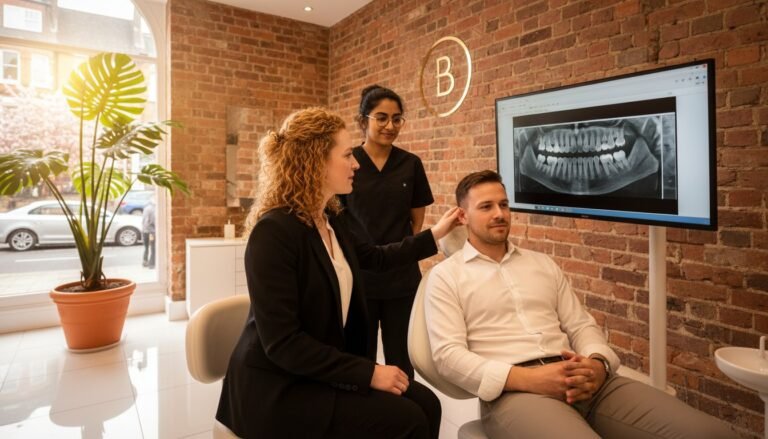

A gap in your smile can do more than just affect your confidence; it can leave you feeling anxious and unsure about the best next step. When faced with complex procedures and confusing terms, it’s completely normal to worry about making the right choice for your health and your budget. We understand. For many, a dental bridge is a caring and highly effective treatment for replacing a missing tooth, designed to help you eat, speak, and smile with complete comfort again.
In this complete UK guide, our goal is to provide calm, clear answers to all your questions. We will gently walk you through the different types of bridges, explain the procedure in simple terms, and provide a transparent look at typical UK costs in pounds (£). We’ll also explore how a bridge compares to other treatments, such as saving a tooth with a root canal. By the end, you will feel empowered to make a skilled, informed decision that restores not just your smile, but your peace of mind.
Key Takeaways
- Discover the four main types of dental bridges and learn which solution may be best suited for your unique needs.
- Feel reassured by understanding the simple, multi-step procedure for fitting a bridge, which is always focused on your comfort.
- Confidently weigh your options by comparing a dental bridge to alternatives like implants to make the right choice for your smile.
- Gain clarity on the typical costs for bridges in the UK and the key factors that influence the final price of your treatment.
What is a Dental Bridge and Why Might You Need One?
Losing a tooth can feel unsettling, but there are calm and effective ways to restore your smile. In simple terms, a dental bridge is a custom-made restoration designed to fill the gap left by one or more missing teeth. Its primary purpose is to literally ‘bridge’ this space, using the healthy teeth on either side for support. This is a trusted, long-standing solution for replacing missing teeth, restoring not just the look of your smile but its full function, too. For a more technical explanation, you can read about what is a dental bridge on Wikipedia, but our goal here is to provide a clear and reassuring overview.
Leaving a gap in your smile is more than just a cosmetic concern. A missing tooth can cause the surrounding teeth to drift into the empty space, leading to a misaligned bite, issues with your jaw, and even difficulty chewing. Over time, this can also affect your speech and the shape of your face. A dental bridge provides a stable, fixed solution that prevents these problems, offering comfort and peace of mind while protecting your long-term oral health.
The Anatomy of a Bridge: Abutments and Pontics
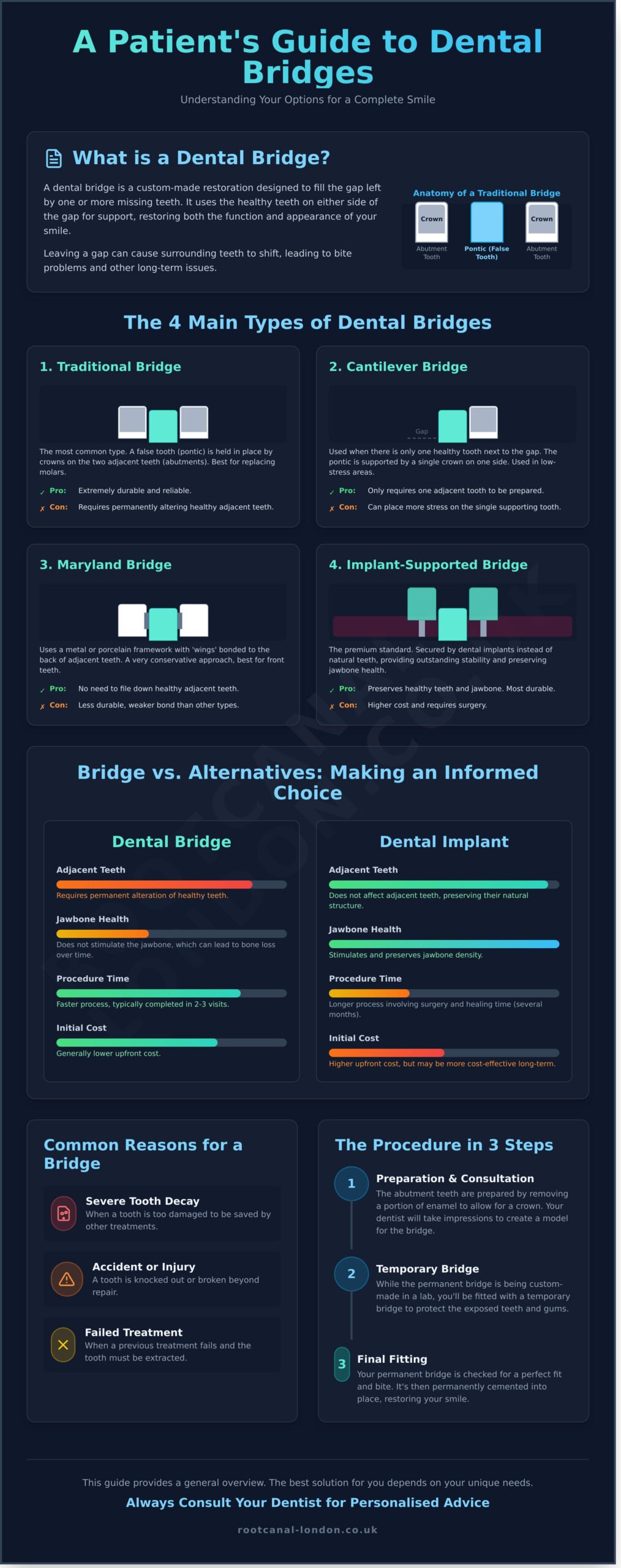
Understanding a bridge is simple when you think of its two main parts. The supporting teeth on either side of the gap are called abutments. These are typically fitted with crowns for strength. The artificial tooth that fills the gap is called the pontic. A helpful analogy is to imagine a real bridge: the abutment teeth act as the strong support pillars, while the pontic is the road that connects them, completing the structure.
Common Reasons for Needing a Dental Bridge
You might need a bridge for several reasons, all of which are focused on restoring your mouth to a state of comfort and health. Our caring team will always discuss the best options for your specific situation. Common reasons include:
- Severe Tooth Decay: When a tooth is too damaged by decay to be saved with a filling or root canal treatment.
- Accident or Injury: A tooth that has been knocked out or broken beyond repair due to trauma.
- Failed Previous Treatment: A tooth that must be extracted after a root canal or other treatment has failed.
- Congenitally Missing Teeth: A less common situation where an adult tooth never develops in the first place.
The 4 Main Types of Dental Bridges Explained
Choosing the right tooth replacement is a significant step towards restoring your smile and confidence. A dental bridge is an excellent solution, but it’s important to know that several options are available. The best choice for you will depend on factors like the location of the missing tooth and the health of the surrounding teeth. To help you understand your options, we’ve broken down the four main types of dental bridges our skilled dentists may recommend.
Traditional Dental Bridges
This is the most common type of dental bridge. It consists of a false tooth (a pontic) held in place by dental crowns that are cemented onto the two teeth on either side of the gap. These supporting teeth are known as abutment teeth. Traditional bridges are very strong and are often the preferred choice for replacing molars, which endure significant chewing forces.
- Pro: Extremely durable and reliable for long-term use.
- Con: Requires permanently altering healthy adjacent teeth to fit the crowns.
Cantilever and Maryland Bridges
These are more conservative options used in specific situations where a traditional bridge may not be suitable. They are designed to preserve more of your natural tooth structure.
A Cantilever bridge is used when there is only one healthy tooth next to the gap. The false tooth is supported by a single crown on just one side. This is less common and typically used in areas with lower chewing stress.
- Pro: Only requires one adjacent tooth to be prepared.
- Con: Can place more stress on the single supporting tooth.
A Maryland bridge uses a metal or porcelain framework with ‘wings’ that are bonded to the back of the teeth on either side of the gap. This is a very conservative approach as it doesn’t require crowns.
- Pro: No need to file down healthy adjacent teeth.
- Con: Less durable and best suited for replacing front teeth with a weaker bite force.
Implant-Supported Bridges
Considered the premium standard in modern tooth replacement, an implant-supported bridge is secured by dental implants rather than natural teeth. One implant is surgically placed for every missing tooth, or a bridge can be supported by two implants on either side of a larger gap. This method provides outstanding stability and preserves the health of your jawbone.
- Pro: Does not require altering healthy teeth and helps prevent bone loss.
- Con: The most invasive and time-consuming option, as it requires surgery.
The Dental Bridge Procedure: A Reassuring Step-by-Step Overview
The thought of any dental procedure can be daunting, but we want to assure you that receiving a dental bridge is a straightforward and predictable process. Our focus is always on your comfort and achieving an outstanding, natural-looking result. The entire journey is typically completed over two visits, managed with gentle care and precision by our skilled team.
To ensure a completely pain-free and calm experience, we use an effective local anaesthetic to numb the area before we begin any preparation. You can relax knowing you are in caring and expert hands from start to finish.
Your First Visit: Consultation and Preparation
This initial appointment is all about careful planning and preparation. We begin with a thorough examination, which may include X-rays, to assess the health of the supporting teeth and jawbone. We will discuss your treatment plan in detail, answering any questions you may have.
Once you are comfortable, we will gently reshape the abutment teeth-the teeth on either side of the gap-to create the ideal foundation for the crowns that will anchor your bridge. We then take precise impressions of your teeth, which are sent to a specialised dental laboratory. There, expert technicians will craft your bespoke dental bridge. Before you leave, we will fit a temporary bridge to protect the prepared teeth and maintain your smile’s appearance.
Your Second Visit: Fitting Your Permanent Bridge
When you return for your second visit, your custom-made permanent bridge will be ready. We start by carefully removing the temporary bridge and thoroughly cleaning the teeth underneath. Your dentist will then place your new bridge, meticulously checking the fit, alignment with your bite, and the colour match to ensure it blends seamlessly with your natural teeth.
Your satisfaction is our priority. Only when you and your dentist are completely happy with the result will the bridge be permanently secured in place with strong dental cement. This final step completes the dental bridge procedure, restoring not just the gap in your smile but also your ability to chew and speak with renewed confidence.
Bridge vs. Alternatives: Saving Your Tooth vs. Replacing It
When you have a missing or severely damaged tooth, understanding your options can feel overwhelming. Our goal is to provide clear, compassionate guidance to help you make the best choice for your long-term health and comfort. While a dental bridge is an excellent solution for replacing a missing tooth, it’s important to compare it with other treatments and, most importantly, to see if replacement is necessary at all.
Dental Bridge vs. Dental Implant
The two most common ways to replace a missing tooth are a bridge or a dental implant. Each has distinct advantages, and the right choice depends on your specific situation.
- Dental Implant: This involves surgically placing a titanium post into your jawbone, which acts as a new tooth root. It is a standalone solution that does not affect the neighbouring teeth. While the process requires surgery and can have a higher initial cost, implants are incredibly durable and can last a lifetime with proper care.
- Dental Bridge: A bridge is a less invasive option as it doesn’t require surgery on the jawbone. It is often a faster and more cost-effective solution initially. However, it relies on the adjacent teeth for support, which must be filed down and crowned, even if they are perfectly healthy.
The Best Alternative: Can Your Natural Tooth Be Saved?
At our practice, we believe that nothing is better than your own natural tooth. Extraction and replacement should always be the very last resort. If you are experiencing pain or have a badly damaged tooth, the first and most important question we ask is: can we save it?
Often, the answer is yes. Through skilled endodontic care, such as a root canal treatment, we can remove infection from deep inside the tooth, relieve your pain, and save its structure. Once the tooth has been treated, it can be protected with a custom-made crown. This restores its strength and appearance, allowing it to function just like any other tooth. This caring approach avoids the need for extraction and a subsequent bridge or implant altogether.
If you have a painful tooth, book a consultation to see if it can be saved. We are here to provide a calm, reassuring, and pain-free experience.
Dental Bridge Costs in the UK & Long-Term Care
Understanding the investment required for a dental bridge is a crucial step in planning your treatment. We believe in complete transparency, helping you make a confident and informed decision about restoring your smile. The final cost is an investment not just in a replacement tooth, but in your long-term oral health and comfort.
Understanding Dental Bridge Costs in London and the UK (2025)
The investment for a high-quality dental bridge can vary, primarily influenced by the type of practice and your geographical location. As a leading private practice in London, Bespoke Dental Fulham offers advanced treatment options. In London, you can generally expect prices to reflect the higher quality of materials and expertise, often at the higher end of the national average due to increased overheads.
- Advanced Private Treatment: At Bespoke Dental Fulham, we offer a wide choice of advanced materials for superior aesthetics, durability, and a custom fit. Prices are typically quoted per ‘unit’ (each crown and pontic). A typical three-unit bridge designed to replace one missing tooth could range from £2,200 to £6,000+, depending on the specific materials and complexity outlined below.
Factors That Influence the Final Price
Several key elements determine the overall cost of your treatment. During your consultation, we will provide a detailed breakdown based on your unique needs.
- Material Used: High-performance, aesthetic materials like all-porcelain or zirconia are more premium than traditional porcelain-fused-to-metal (PFM) options.
- Number of Teeth: The more teeth being replaced, the larger the bridge required, which increases the cost of materials and clinical time.
- Case Complexity: If the supporting abutment teeth require prior treatment, such as a root canal or core build-up, this will be an additional and necessary investment.
How to Care for Your Dental Bridge
The longevity of your dental bridge depends entirely on your commitment to excellent oral hygiene. With outstanding care, it can serve you beautifully for 10-15 years or even longer. Your daily routine is the key to protecting your investment.
It is absolutely vital to clean underneath the false tooth (the pontic) every day. Plaque can easily accumulate here, leading to gum inflammation and decay in the supporting teeth. We recommend using specialist tools like floss threaders, interdental brushes, or a water flosser to effectively clean this space.
Finally, never miss your regular dental check-ups and hygiene appointments. Professional cleanings and examinations allow us to monitor the health of your bridge and the surrounding tissues, ensuring any potential issues are addressed early. If you need specialist advice or a comprehensive assessment, the caring team at Bespoke Dental Fulham is here to help.
Making the Right Choice for Your Smile
Navigating the world of tooth replacement can feel overwhelming, but you’re now equipped with a clear understanding of what a dental bridge involves. From the different types available to the procedure and typical UK costs, you have the essential information to consider your options. The most important takeaway is that while bridges are an excellent solution for missing teeth, exploring whether your natural tooth can be saved should always be the first step.
At Bespoke Dental Fulham, our first priority is always to explore all options to save your natural teeth. Before making a final decision about a dental bridge, our experienced team can provide expert care with a compassionate and reassuring approach, focusing on what’s best for your long-term oral health. Don’t let uncertainty or pain dictate your next move; get a professional opinion first.
Considering a dental bridge or have a damaged tooth? Book a consultation with Bespoke Dental Fulham. Taking this first step is the best way to find clarity and a comfortable path forward for your smile.
Frequently Asked Questions About Dental Bridges
How long does a dental bridge typically last?
With excellent care and oral hygiene, a dental bridge can last between 5 and 15 years, and sometimes even longer. The lifespan depends on the health of the supporting teeth and your commitment to regular dental check-ups and cleanings. Avoiding very hard foods and habits like chewing ice will also help ensure your bridge provides a long-lasting, comfortable solution for your smile. We are always here to offer guidance on protecting your restoration for years to come.
Is it difficult to eat with a new dental bridge?
There is a brief adjustment period after your new bridge is fitted. We recommend starting with soft foods and cutting things into smaller pieces to ease yourself in. Most patients find that within a few days, eating feels completely normal and comfortable again. It’s important to chew on both sides of your mouth to distribute pressure evenly. Soon, you’ll be enjoying your favourite foods with renewed confidence and comfort.
How do you properly clean under a dental bridge?
Keeping the area under your bridge clean is vital for gum health and the longevity of your restoration. Standard floss cannot pass through, so we recommend using a floss threader, interdental brushes, or a water flosser. These tools allow you to gently guide the floss under the artificial tooth (the pontic) to remove plaque and food particles. Our team will provide a demonstration to ensure you feel confident and comfortable with your new cleaning routine.
Can a dental bridge be removed and re-cemented if it comes loose?
If your bridge feels loose, please contact us immediately. In many cases, if the bridge itself and the supporting teeth are undamaged, it can be professionally cleaned and re-cemented. However, it’s crucial for us to first determine why it came loose, as this could indicate an underlying issue with a supporting tooth. Your comfort and oral health are our priorities, so we will ensure the foundation is secure before re-fitting your restoration.
What are the main disadvantages of getting a dental bridge?
The primary disadvantage is that a traditional dental bridge requires the preparation of healthy teeth on either side of the gap. These teeth must be filed down to accommodate the crowns that anchor the bridge, a process which is irreversible. Additionally, meticulous cleaning is required to prevent plaque build-up underneath the bridge, which could lead to decay in the supporting teeth. We will discuss all options with you to ensure you make the best choice for your long-term health.
Can you get a bridge if you have gum disease?
It is essential to have healthy gums before proceeding with a bridge. Active gum disease (periodontitis) can weaken the bone and gums that support the anchor teeth, potentially leading to the failure of the bridge. We would first focus on treating the gum disease to create a stable and healthy foundation. Once your gums are healthy, we can then confidently move forward with creating a strong, secure, and lasting tooth replacement for you.
Will a dental bridge look like my natural teeth?
Absolutely. We take great care to ensure your new bridge blends seamlessly with your natural smile. Using high-quality materials like porcelain, we meticulously match the colour, shape, and size of the artificial tooth to your surrounding teeth. Our goal is for your restoration to be virtually indistinguishable from your natural teeth, restoring not just your ability to chew, but also the confidence that comes with a beautiful, complete, and natural-looking smile.