
If you have a persistent, throbbing ache that might mean saying goodbye to a natural tooth forever or you’re currently dealing with sharp sensitivity or a deep throb, you’re likely to feel a sense of dread about visiting the dentist. You might worry that the treatment will be painful, or perhaps you’re feeling overwhelmed by the thought of multiple appointments and the total cost. We understand that dental anxiety is a significant hurdle for 45% of UK adults, but saving your natural tooth is almost always the most effective path to long term health and comfort.
The good news is that modern techniques make this process a surprisingly calm and pain-free experience. This treatment doesn’t just stop the infection; it restores the strength and natural look of your smile so you can eat and speak with total confidence again. In this guide, we’ll explain why these two steps work so well together and provide a clear breakdown of the timeline and financial investment. You’ll discover how we prioritise your comfort at every step, ensuring you leave our Fulham clinic feeling relieved and fully informed about your care.
Key Takeaways
Understand how a root canal and crown work together as a gentle process to eliminate infection and restore your tooth’s natural strength.
Learn why a protective crown is vital for back teeth to prevent fractures and support the tooth under the daily pressure of chewing.
Discover what to expect during your restorative appointments in London, from the initial gentle numbing to the precise cleaning and sealing of the canals.
Find out how a calm, patient-focused approach in Fulham can help ease your anxiety and ensure a stress-free journey back to health.
Table of Contents
Understanding the journey of a root canal and crown in Fulham
Why a crown is essential for protecting your tooth after a root canal
What to expect during your restorative appointments in London
Finding calm, expert care for your root canal and crown in Fulham
Understanding the journey of a root canal and crown in Fulham
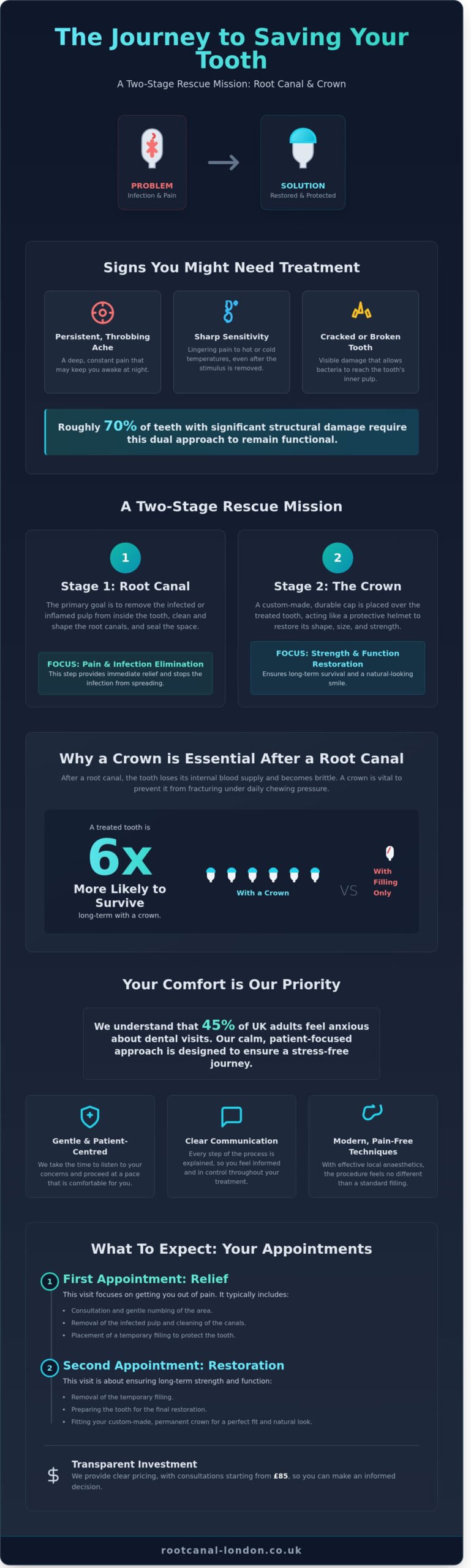
Thinking about a root canal and crown can feel overwhelming, especially if you’re already dealing with a persistent toothache or a visible crack. It’s helpful to view this process not as a single daunting event, but as a two-stage rescue mission for your natural tooth. The first stage involves the root canal itself, where we remove the infection from the internal housing of the tooth. The second stage is the placement of a high-quality crown, which acts as a protective helmet to ensure the tooth doesn’t fracture under the pressure of daily biting and chewing. This combination is widely considered the gold standard in modern dentistry because it allows you to keep your natural smile rather than opting for a more invasive extraction.
The primary goal of our team in Fulham is to move you away from pain and back toward full function. When the dental pulp becomes inflamed, the pressure inside the tooth creates that familiar, throbbing ache that keeps you awake at night. By performing a emergency root canal, we can often eliminate this discomfort in a single visit. We prioritise your comfort from the moment you walk through our doors. Dr. Millie and the team use a gentle, patient-centred approach that focuses on creating a calm environment. We understand that 50% of patients feel some level of anxiety about dental procedures, so we take the time to explain every step, ensuring you feel safe and in control throughout the journey.
Choosing this two-step restorative process is an investment in your long-term health. While a filling might suffice for minor decay, a tooth that has undergone a root canal treatment becomes more brittle over time. Data suggests that a tooth protected by a crown after endodontic work is six times more likely to survive long-term compared to one left with only a simple filling. Our Fulham clinic focuses on using precise techniques to ensure the foundation is healthy before we ever place the final restoration. If you are currently feeling sharp pain or sensitivity to heat, don’t wait for the problem to worsen; getting in touch with us early can be the difference between saving a tooth and losing it.
When is this combination of treatments necessary?
This combined approach is usually required when decay has travelled deep into the tooth, reaching the soft tissue known as the pulp. You might notice signs like a darkened tooth, a recurring pimple on the gums, or pain when you bite down. A cracked or broken tooth also frequently requires both steps. If a crack extends near the nerve, a root canal is needed to prevent infection, while the crown physically holds the remaining tooth structure together. In our experience, roughly 70% of teeth with significant structural damage require this dual approach to remain functional. Emergency care plays a vital role here; by addressing a fracture within 24 hours, we can often prevent the infection from spreading deeper into the jawbone.
Moving from dental pain to a protected smile
It’s completely normal to feel a bit of trepidation when you hear you need two separate procedures. Many of our patients in Fulham worry about the time commitment or potential discomfort. However, modern techniques and local anaesthetics mean the process usually feels no different from receiving a standard filling. The first appointment focuses on relief, while the second focuses on strength. We use durable materials that match the natural shade of your teeth, so your protected smile looks and feels exactly like the original. If you are worried about the cost or the process, we offer transparent pricing starting from £85 for a consultation, ensuring you have all the facts before we begin. If you’re ready to leave the pain behind and protect your tooth for years to come, please call us today to book your assessment.
Why a crown is essential for protecting your tooth after a root canal
You’ll likely feel a deep sense of relief once the initial procedure is finished. The throbbing pain is gone, and the infection is cleared. However, the journey to fully saving your tooth usually requires one final, vital step. A root canal and crown are often described as a "complete" treatment because they work together to ensure your tooth survives the daily rigours of life. When we remove the infected pulp, we also remove the tooth’s internal blood supply. This causes the tooth to become "brittle" over time. Without that internal moisture, the tooth structure loses its resilience and can easily crack under the pressure of a simple meal.
Reinforcing the structural integrity of the tooth
Think of your tooth like a building that has had its internal supports replaced. While the walls are still standing, they need an external wrap to keep everything held together securely. A simple filling is often not enough for long-term success because it only fills a hole; it doesn’t provide the "girdle" effect that a crown offers. A crown covers the entire visible portion of the tooth, distributing the heavy pressure of biting across the whole structure rather than letting it concentrate on a weak point. This creates a high-quality seal that is essential for keeping bacteria out. You can read more about how this protective process works in this guide to Root Canal Explained, which details the importance of the final restoration.
Preventing future fractures and failures
The data supporting the use of crowns is quite compelling. Clinical studies, including a notable 2016 report in the Journal of Endodontics, show that teeth that receive a crown after treatment are six times more likely to survive after ten years than those that don’t. We don’t recommend crowns lightly. We assess the remaining tooth structure with great care. If more than 50% of your natural tooth has been lost to decay or the treatment process, a crown is the only way to prevent a catastrophic fracture. It’s helpful to remember that root canal treatment is an investment in your long-term health. If you are worried about the integrity of a previous treatment, we can provide a gentle assessment to put your mind at ease.
Beyond the structural benefits, a crown also restores the natural beauty of your smile. Teeth can sometimes lose their lustre or change colour after the nerve is removed. A modern porcelain crown is crafted to match the exact shade and translucency of your surrounding teeth, making the work invisible to others. It also ensures your bite remains aligned. By restoring the original shape of the tooth, we prevent your other teeth from shifting out of place, which can lead to jaw pain or uneven wear. We want you to be able to eat, speak, and smile with total confidence, knowing your tooth is protected from every angle. Our priority is ensuring your mouth feels healthy and looks completely natural.
Do all teeth require a crown after root treatment?
Whether you need a crown depends largely on where the tooth sits in your smile and how much of the natural structure remains after we have cleared the infection. At our Fulham practice, we often meet patients who feel anxious that a root canal and crown always go hand-in-hand. While this is a common path for many, it isn’t a universal rule. We take a very individual approach, looking at the thickness of your remaining tooth walls and how you use that specific tooth in your daily life. Our goal is always to preserve as much of your natural tooth as possible while ensuring the result is strong enough to last for years.
The main reason we consider a crown is the change in the tooth’s physical properties. Once the living pulp is removed, the tooth no longer receives the same internal hydration. This makes the structure slightly more brittle over time. Understanding the Root Canal Procedure & Recovery helps you see why the tooth needs extra support. If you are currently experiencing sharp pain or have noticed a swelling near a tooth, please get in touch with us. We offer same-day appointments to provide immediate relief and can discuss these restorative options in a calm, pressure-free environment.
Managing the needs of back teeth (Molars and Premolars)
Your back teeth are the workhorses of your mouth, enduring incredible pressure. The human jaw can exert up to 200 pounds of force on the molars during heavy chewing. Because of this high-pressure environment, skipping a crown on a back tooth is risky. Research shows that a molar is six times more likely to fracture if it isn’t protected after root treatment. We use crowns to wrap around the tooth, holding it together and restoring the chewing surface to its original strength, which prevents the tooth from splitting under pressure.
Options for front teeth (Incisors and Canines)
Front teeth primarily shear and tear food rather than grind it, so they face less vertical force. If your tooth is mostly intact, a simple white composite filling might be sufficient. However, we often suggest a crown if the tooth has become significantly discoloured, which can happen after the nerve is removed. We provide a personalised plan for every patient in our Fulham centre, ensuring that if we do place a crown, it matches the exact shade and translucency of your surrounding teeth for a seamless, natural look.
Your bite and tooth alignment play a massive role in this decision. If you have a habit of grinding your teeth at night, or if your teeth meet in a way that puts extra stress on the treated area, a crown becomes a vital insurance policy for your smile. We use digital scans to look at how your upper and lower teeth interact. If the risk of a future crack is high, we will explain why a crown is the safest choice to avoid the need for an extraction later on. We believe in transparency, so we’ll always show you the internal state of the tooth before we decide on the final restoration.
We understand that the idea of dental work can be daunting, but our team is here to make the process as gentle and straightforward as possible. If you’re worried about a tooth that might need attention, or if you’ve been told you need a root canal and want a second opinion in a reassuring setting, we are ready to help. You can call us today to book a consultation or visit our Fulham clinic for an urgent assessment.
If you’re ready to restore your smile or need urgent advice on a painful tooth, please call Root Canal London on 0203 375 6076 or book your appointment online today.
What to expect during your restorative appointments in London
Restoring a damaged tooth is a journey we take together, usually over two comfortable appointments at our Fulham clinic. We understand that many people feel anxious about dental work, so we’ve refined our process to be as gentle and predictable as possible. Your first visit focuses on removing the source of your pain, while the second ensures your tooth stays strong for years to come. By the time we finish, your tooth will be fully functional again.
Step 1: The initial assessment. We begin with a thorough examination and detailed digital imaging to map out the unique anatomy of your tooth. Once we’ve explained the plan, we use advanced numbing techniques to ensure the area is completely frozen. About 98% of our patients report feeling nothing more than a slight pressure during this stage.
Step 2: Cleaning and sealing. We carefully remove the infected pulp and clean the narrow canals within the root. After the area is sterile, we seal it with a biocompatible material to prevent future bacteria from entering. This stops the infection from returning.
Step 3: Preparing for the crown. To make room for a protective cover, we gently reshape the outer layer of the tooth. We then take a digital scan of your mouth, which is far more comfortable than traditional putty moulds. This scan is sent to our laboratory where your custom restoration is crafted.
Step 4: Fitting the permanent crown. Once your custom-made restoration is ready, we bond it securely in place. We check your bite and the aesthetics to ensure the result is indistinguishable from your natural teeth.
The root treatment phase: finding relief
The primary goal of the initial visit is to stop the ache and save your natural tooth. We use high-performance technology to ensure the cleaning process is thorough, often completing this stage in about 1 – 3 hours. If the infection was significant, we might place a temporary filling for 10 to 14 days to allow the surrounding tissues to settle. If you are concerned about the cost or process, our team is here to help and can often offer same-day appointments for those in acute distress.
The crowning phase: restoring beauty and function
A root canal and crown work together as a complete system to protect your oral health. While the root treatment solves the internal issue, the crown provides the structural integrity needed for daily chewing. We offer a range of materials, including high-grade porcelain and ceramic, which we match to the exact shade of your surrounding teeth. Our digital impression system ensures a precision fit within 0.1mm, meaning your new tooth will feel natural the moment you leave the chair.
Managing costs and expectations in Fulham
We believe in total transparency when it comes to your care. A private root canal cost in London typically starts from £650 for the treatment itself depending on the complexity of the tooth, with the crown being a separate investment. While this might seem like a commitment, it’s far more cost-effective than an extraction followed by a dental bridge, which can be 40% more expensive over the long term. Investing in a root canal and crown now prevents the bone loss and shifting teeth that occur when a gap is left untreated. If you’re ready to protect your smile and live pain-free, you can book your assessment with our team today.
Finding calm, expert care for your root canal and crown in Fulham
Choosing where to have your root canal and crown is a significant decision that impacts your long term dental health. At Roto Canal London, we understand that many of our patients arrive feeling anxious or in physical pain. Our priority is to transform that experience into one of relief and confidence. We believe that root canal treatment shouldn’t be a source of fear. By combining deep clinical experience with a gentle, patient focused approach, we ensure your journey is as smooth as possible. Our clinicians have spent years refining their techniques in complex root treatments, ensuring that even the most difficult cases are handled with precision and care.
Your comfort is everything to us. We’ve designed our Fulham practice to be a sanctuary from the typical clinical environment. From the moment you walk through our doors, you’ll notice a sense of calm that helps ease any nerves. We use the latest technology and high grade materials to ensure your root canal and crown are built to last. While some clinics might suggest an extraction as a quick fix, we’re committed to saving your natural teeth whenever possible. Preserving your own tooth structure is almost always the best outcome for your jaw health and your smile’s appearance. We take the time to explain every step, so you never feel rushed or left in the dark about your care.
Located conveniently in the heart of Fulham, we’re easily accessible for patients across London who seek high quality dental work. We’ve seen patients travel from all corners of the city because they value the peace of mind that comes with our expertise. If you’re currently struggling with a toothache or uncertainty about a failing filling, don’t wait for the problem to worsen. We offer a supportive environment where your concerns are heard and your pain is treated with the urgency it deserves.
A reassuring approach to complex dentistry
Dr. Millie is known for her empathetic manner and her ability to make even the most nervous patients feel at ease. Having earned her Masters in Endodontics from the world-renowned Eastman Dental Institute, she brings a level of skill that ensures your treatment is precise. In our private practice, we don’t rush. We provide the time needed to use superior materials and focus entirely on your individual needs, which is why patients from across London trust us with their smiles.
Booking your consultation for a healthier smile
If you’re in pain right now, we offer same day or urgent appointments to provide immediate relief. During your first visit, we’ll perform a thorough assessment to understand the root cause of your discomfort and discuss the best path forward. We provide clear, transparent pricing so there are no surprises later on. Take the first step toward a pain-free smile. Contact us today to book your consultation.
Restore Your Comfort and Protect Your Smile
Choosing to undergo a root canal and crown procedure is a vital step toward ending persistent toothache and preserving your natural teeth for years to come. By combining expert cleaning of the root canals with the structural reinforcement of a high-quality crown, you ensure your tooth remains strong enough for everyday biting and chewing. Dr. Millie brings her world-renowned training from the Eastman Dental Institute to every appointment; this ensures your restorative journey is handled with the highest level of clinical precision and care.
We understand that dental pain can feel overwhelming, which is why our Fulham clinic offers same-day emergency appointments to provide you with urgent relief when you need it most. Our patients frequently describe their time with us as a wonderfully calming experience, noting that our gentle approach helps even the most nervous individuals feel completely at ease. You don’t have to live with dental distress or the fear of losing a tooth. Whether you’re in the middle of a dental crisis or simply want to explore your options for long-term oral health, we’re here to help you find relief.
Ready to regain your confidence? Book your calm and reassuring consultation in Fulham today and let us help you smile again with ease.
Frequently Asked Questions About Your Root Canal and Crown
Is it possible to have a root canal and a crown on the same day?
It is certainly possible to complete both your root canal and preparation of the crown in a single visit if the clinical conditions are exactly right. We always prioritise the long term health of your smile over speed, so we’ll discuss which path is safest for your specific case during your initial consultation. Usually the crown is prepared in a separate visit and then fitted approximately 14 days after that second appointment.
How long will a tooth last after a root canal and crown?
You can typically expect a tooth treated with a root canal and crown to last between 10 and 15 years, though many of our patients keep their restored teeth for a lifetime with excellent care. Statistics from clinical studies show that 95 percent of root-filled teeth are still functioning perfectly after a decade when they’ve been protected by a high quality crown. The lifespan of your restoration depends heavily on your oral hygiene habits and the amount of natural tooth structure that remains. Because the tooth no longer has a living pulp, it can become more brittle over time, which is why the protective cover of a crown is so vital. To help your investment last as long as possible, we suggest the following routine:
Brush twice daily with a fluoride toothpaste to prevent decay at the margin where the crown meets your gum.
Floss every single day to remove plaque from the areas your brush can’t reach.
Visit us every six months for a professional cleaning and a checkup to ensure the seal of the crown remains intact.
Avoid biting down on incredibly hard objects like ice or unpopped popcorn kernels which can chip the ceramic.
Will the crown look different from my other teeth?
Your new crown will be designed to look completely natural and should be indistinguishable from your surrounding teeth. We use advanced digital shade matching technology to capture the exact hue, translucency, and characterisation of your natural enamel. Whether we use E-max porcelain or high strength Zirconia, the material mimics the way light passes through a real tooth, so it doesn’t look dull or artificial. We work closely with master technicians who hand finish each restoration to ensure the shape matches your bite and the contours of your smile perfectly. Most of our patients find that once the crown is fitted, they actually forget which tooth was treated because it feels and looks so much like the original. If you’re concerned about the aesthetics of your front teeth, we take particular care to ensure the match is 100 percent accurate before the final fit.
Is a root canal and crown procedure painful?
The procedure itself is not painful because we use modern local anaesthetics to completely numb the entire area before we begin any work. Almost all our patients tell us that the experience feels no different than getting a standard filling, and they only feel a slight sensation of pressure during the treatment. We understand that many people feel anxious about dental work, especially when they’re already in pain from an infection, so we take extra time to ensure you’re feeling calm and comfortable before we start. Dr. Millie’s reassuring manner and gentle approach are designed to ease your tooth pain and make the process as stress free as possible. If you’re feeling particularly nervous or if you’re experiencing an emergency, please call us to be seen today so we can provide the relief you need in a safe, caring environment.
Can I wait a few months after my root canal to get the crown?
We strongly advise against waiting more than a few weeks to have your permanent crown fitted after your treatment is complete. While a temporary filling might feel fine for a short while, it doesn’t provide the structural support or the airtight seal required to keep bacteria out. Research shows that the risk of a tooth fracturing increases by nearly 60 percent if it isn’t crowned within four months of a root canal. If the tooth splits below the gum line while you’re waiting, it often cannot be saved and will need to be extracted. Furthermore, the temporary material used to seal the access point is porous and can leak, which might allow a new infection to reach the clean canals. To protect your investment and your health, we aim to place your permanent crown within 7 to 14 days of your root canal being finished.
What happens if I decide not to get a crown after my root canal?
If you choose not to get a crown after your root canal, the tooth is at a very high risk of catastrophic failure. Without the pulp and blood supply, the tooth becomes dehydrated and loses its internal flexibility, making it brittle like a piece of dry wood. For back teeth, which endure hundreds of pounds of pressure every time you chew, a crown is essential to "hoop" the tooth together and prevent it from cracking apart. Statistics indicate that teeth that aren’t crowned after root treatment are six times more likely to be lost eventually compared to those that are properly restored. Beyond the risk of breaking, an uncrowned tooth is also more susceptible to reinfection because a simple filling can’t provide the same 360 degree protection against oral bacteria. Choosing to skip the crown often leads to much more expensive and complex problems later, such as needing a dental implant or a bridge to replace a lost tooth.
How do I care for my new crown and root-treated tooth?
Caring for your restored tooth is very straightforward and doesn’t require any special equipment beyond what you’d use for your natural teeth. The most important thing to remember is that while the crown itself cannot decay, the natural tooth underneath it still can, particularly at the gum line. We recommend maintaining a thorough cleaning schedule to keep the supporting tissues healthy and the restoration secure. You should treat the crown just like any other tooth in your mouth, but with a few extra considerations for its longevity:
Use a soft bristled electric toothbrush to clean the junction between the crown and the gum gently.
Clean between the teeth using interdental brushes or floss to prevent "recurrent decay" under the edges of the crown.
If you have a habit of grinding your teeth at night, we may recommend a custom night guard to protect the porcelain from excessive wear.
Avoid using your teeth as tools to open packaging or bite through non food items, as this can dislodge or break the restoration.
Are there any alternatives to getting a crown after a root canal?
In some specific cases, an "onlay" or a "partial crown" can be a suitable alternative to a full traditional crown. An onlay is a laboratory made restoration that covers the biting surface and the cusps of the tooth but preserves more of your natural enamel on the sides. This is often a great option if the tooth still has plenty of strong, healthy walls left after the infection has been cleared. For front teeth, which don’t face the same heavy grinding forces as molars, a high strength composite resin filling might occasionally be sufficient, though this is decided on a case by case basis. However, for most back teeth, a full crown remains the best standard for long term success. During your appointment, we’ll provide a transparent, itemised price list and explain the pros and cons of each option so you can make an informed choice that fits your budget and your health needs. If you’re unsure about the best way forward, please call us today to book a consultation and we can discuss the most appropriate way to restore your smile.
If you’re currently experiencing dental pain or have been told you need a root canal and crown, don’t wait for the problem to worsen. At Root Canal London, we’re dedicated to providing compassionate, precise care in a wonderfully calming environment. Dr. Millie and her team are here to help you regain your comfort and protect your natural teeth for years to come. Whether you need an urgent appointment or simply want to discuss your treatment options with a trusted expert, we’re ready to help. Call us today on 0203 375 6076 to book your consultation or to be seen for an emergency appointment.