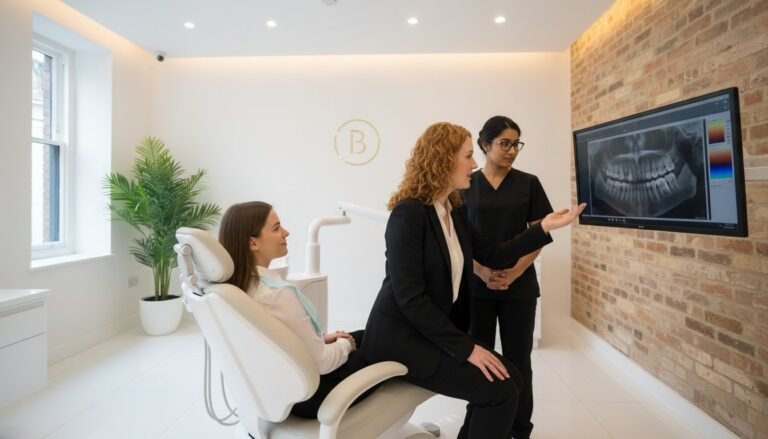

Facing the prospect of a root canal can be daunting. You’re likely in pain, and on top of that, you may be worried about the procedure itself, how your tooth will look afterwards, or if it will feel strong again. We hear these concerns every day, and our first priority is always your comfort and peace of mind. We believe that understanding your treatment is a powerful step towards feeling calm and in control.
That is why we’ve created this caring, visual guide. Here, you will see the complete journey through real root canal before and after images, from the first signs of infection on an X-ray to the final, beautifully restored tooth. Our goal is to demystify the process, ease your anxieties, and show you the clear, positive transformation that awaits. Let us walk you through every step towards a healthy, pain-free smile, so you can feel completely reassured and confident in your treatment.
Key Takeaways
- Learn to recognise the key signs of a tooth infection, from discolouration to gum swelling, that signal it’s time to find lasting pain relief.
- Understand how modern root canal treatment is a calm and comfortable procedure designed to eliminate your pain, not cause it.
- See real root canal before and after images, from detailed X-rays to full smiles, to appreciate the transformation to a healthy tooth.
- Discover how a successfully treated tooth can look and feel completely natural for years to come, often lasting a lifetime with the right care.
The ‘Before’ State: Visual Signs and Symptoms of an Infected Tooth
We understand that the journey to considering a root canal often starts with persistent pain and anxiety. That constant, throbbing ache or a tooth that has become exquisitely sensitive can disrupt your daily life. It’s important to know that these symptoms are your body’s way of signalling a problem, and a root canal is not the cause of pain-it’s the solution that brings lasting relief.
Recognising the signs of an infected tooth is the first step toward a pain-free future. Looking at root canal before and after images starts with understanding this crucial ‘before’ stage, where the problem lies.
What You Might See and Feel
An infected tooth pulp can manifest in several ways, some visible to the naked eye and others felt as intense discomfort. These are the most common indicators that you may need Expert endodontic care:
- Severe, Persistent Pain: A throbbing toothache that may wake you up at night.
- Sensitivity to Temperature: Lingering pain after exposure to hot or cold food and drinks.
- Pain on Chewing: Sharp pain or pressure when you bite down.
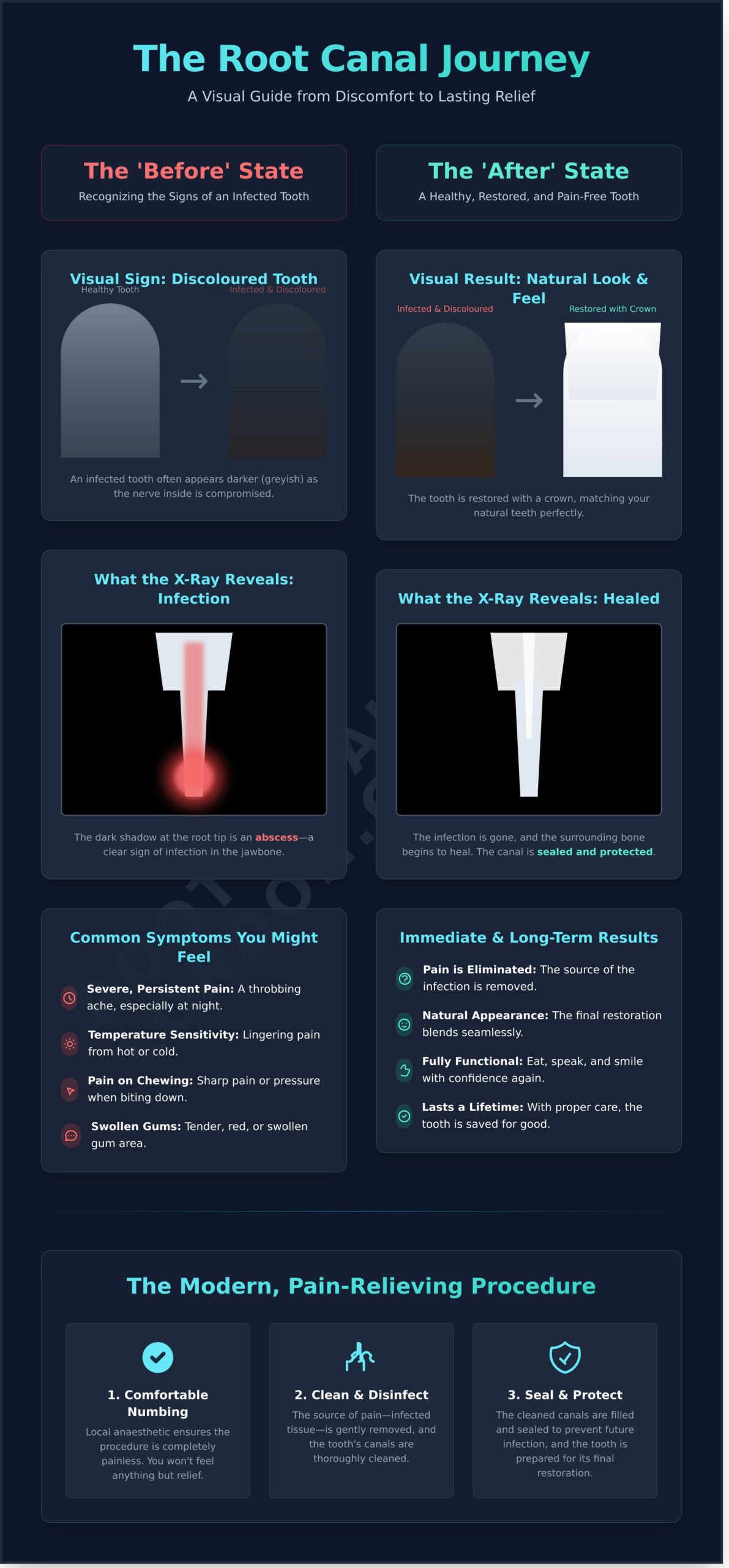
- Discoloured Tooth: The tooth may appear darker, often greyish, as the nerve inside dies.
- Swollen Gums: The gum area around the tooth may be tender, red, and swollen.
- A Pimple on the Gum: A small, recurring pimple (known as a fistula) may appear on the gum, which can release pus from the infection.
A discoloured tooth is a common visual sign that the nerve inside has been compromised.
What the X-Ray Reveals Before Treatment
While your symptoms provide important clues, an X-ray is essential for a definitive diagnosis. It allows us to see the hidden structures of your tooth, including the roots and the surrounding bone. This clear view is crucial for planning your precise and comfortable treatment.
On a ‘before’ X-ray, we often see a dark area at the very tip of the tooth’s root. This shadow, called an abscess, is a clear sign that the infection inside the tooth has spread into the jawbone. This infection is the source of your pain and swelling. The goal of a Root canal treatment is to meticulously clean out this infection, seal the tooth, and allow your body to heal the bone naturally.
The dark spot at the root tip on this X-ray shows the infection (abscess) that the root canal will eliminate.
Seeing this on an X-ray can be worrying, but please be reassured: this is exactly what we are trained to fix. Identifying the problem is the first step towards resolving it and ending your pain for good.
During Treatment: Demystifying the Root Canal Procedure
Many people feel anxious when they hear the words “root canal,” often imagining a painful ordeal. The reality, however, is quite the opposite. A modern root canal is a precise, pain-relieving procedure designed to save your natural tooth and end the discomfort you’re feeling. The difference in a patient’s experience of a root canal before and after the anaesthetic is administered is profound. We ensure the area is completely numb using a local anaesthetic, so you can rest comfortably while we work. The entire process is a highly controlled treatment focused on three main goals:
- Remove the Source of Pain: To gently clear away the infected or inflamed pulp tissue from within the tooth’s canals.
- Clean and Disinfect: To thoroughly cleanse the internal space, ensuring no bacteria remain.
- Seal and Protect: To fill the cleaned canals and seal the tooth to prevent any future infection.
This careful, methodical approach is what transforms a painful ‘before’ state into a calm and healthy ‘after’. For a complete overview of the patient journey, trusted sources like the Cleveland Clinic provide an excellent guide to the Root Canal Procedure and Recovery, reinforcing its effectiveness.
Accessing and Cleaning the Canals
The first step involves creating a tiny opening in the top of the tooth to access the inner pulp chamber. Using highly specialised instruments, your endodontist will carefully and gently remove the damaged pulp from the root canals. This is the most crucial step for pain relief, as it removes the nerve tissue and bacteria that are causing your toothache. Our detailed guide on the root canal treatment process explains this stage with more clarity.
Filling and Sealing the Tooth
Once the canals are meticulously cleaned and shaped, they are filled with a biocompatible, rubber-like material called gutta-percha. This sterile material perfectly seals the canals to prevent bacteria from re-entering. Afterwards, a durable temporary filling is placed over the opening to protect the tooth while it heals. This stabilises the tooth and sets the stage for the final, permanent restoration, which completes its return to full function and appearance.
The ‘After’ Picture: Immediate Results and a Restored Tooth
After your treatment, the first thing you will notice is the profound sense of relief. The persistent, throbbing pain that brought you to us is finally gone. This immediate comfort is the most significant outcome. But beyond that, the ‘after’ stage of treatment is about visually confirming the success and restoring your tooth to its full strength and natural appearance. The complete root canal before and after transformation is both a clinical success and a cosmetic one, giving you back your health and your smile.
The Post-Treatment X-Ray: A Picture of Health
A post-treatment X-ray provides the definitive proof of a successful procedure, offering a clear, internal view of your tooth’s renewed health. It allows us to see what the naked eye cannot.
[Image: Side-by-side comparison of a ‘before’ X-ray showing infection and an ‘after’ X-ray showing filled canals.]
Where the ‘before’ X-ray likely showed a dark shadow at the root’s tip indicating infection, the ‘after’ image is dramatically different. You will see distinct, bright white lines filling the canals precisely to the root tip. This is a biocompatible filling material that seals the cleaned space. This seal is crucial; as the American Association of Endodontists explains, it prevents bacteria from re-entering and causing a new infection, ensuring the long-term health of your tooth.
Final Restoration: From Temporary Filling to Permanent Crown
Immediately after your root canal, we place a temporary filling to protect the tooth while it settles. However, the final step in the journey is just as vital for the tooth’s long-term survival and function.
[Image: A tooth with a temporary filling next to the same tooth restored with a permanent, natural-looking crown.]
A tooth that needs a root canal has often been weakened by extensive decay or a large filling, making it vulnerable to fracture. A permanent dental crown acts like a protective helmet, covering the entire tooth to restore its strength, shape, and function. Each crown is meticulously crafted and colour-matched to blend seamlessly with your surrounding teeth. The result is a tooth that looks, feels, and works just like a natural tooth. We believe in full transparency, and our guide on root canal cost provides a clear breakdown of the fees associated with both the endodontic treatment and the final restoration.
Long-Term Success: How Your Tooth Will Look and Feel Years Later
One of the most common questions we hear is, “Will my tooth last?” It’s a relief for our patients to learn that with proper care, a successfully treated tooth can last a lifetime. The goal of a root canal isn’t just to stop the pain now; it’s to provide a durable, long-term solution that preserves your natural smile for years to come. The true success of a root canal before and after transformation is seeing that same healthy, functional tooth decades later.
[Image: A side-by-side comparison showing a patient’s full, confident smile years after treatment, highlighting how the restored tooth blends in perfectly.]
Aesthetics and Functionality
Once your tooth is restored with a high-quality, custom-made crown, it becomes virtually indistinguishable from your other teeth. It is carefully crafted to match the colour, shape, and size of its neighbours, ensuring your smile looks completely natural. More importantly, it functions just like any other tooth. You can return to eating the foods you love and chewing comfortably, without the fear of pain that troubled you before. The ultimate aim is always to save your natural tooth, maintaining your bite and preventing the shifting that can occur after an extraction.
The Importance of specialised Care for Lasting Results
The long-term success of your treatment is significantly influenced by the expertise of the clinician. An Endodontist specialises in root canal treatment after years of advanced training and uses sophisticated equipment like high-powered microscopes. This expertise allows for an incredibly precise and thorough procedure, which dramatically increases the success rate and prevents the need for future retreatment. Choosing an expert ensures your investment in your oral health is a lasting one. For compassionate and precise care, we invite you to learn more about our root canal endodontist in London.
Finally, remember that your restored tooth needs the same diligent care as all your other teeth. Consistent brushing, flossing, and regular dental check-ups are the cornerstones of ensuring your beautiful root canal before and after results stand the test of time.
Real Patient Journeys: Before-and-After Stories from Our Clinic
While descriptions and diagrams are helpful, nothing tells the story of a successful treatment quite like seeing real patient results. The root canal before and after transformations we see every day are about more than just saving a tooth; they are about ending debilitating pain and restoring a confident smile. Here, with their permission, are a few stories from patients who found relief and renewed confidence at our clinic.
Case Study 1: Relieving Severe Molar Pain
David arrived at our clinic in severe distress. The pain from an infected molar was keeping him awake at night and affecting his daily life. An X-ray quickly revealed a deep infection at the root of the tooth, which required immediate attention.
Before: Infected Molar X-Ray
<!– In a real implementation, an tag would be here –>
After: Restored Tooth
We performed a comfortable emergency root canal to remove the infection and seal the tooth. The procedure provided immediate relief, and the tooth was later restored with a durable crown, blending seamlessly with his other teeth.
“I was incredibly anxious, but the team was so calming and reassuring. The procedure was genuinely pain-free, and the relief I felt afterwards was immense. I can’t thank them enough for getting me out of that awful pain.” – David P.
Case Study 2: Saving a Discoloured Front Tooth
Chloe came to us feeling self-conscious about a front tooth that had turned grey years after a childhood accident. The trauma had caused the nerve inside the tooth to die, leading to the discolouration. She worried she would lose the tooth and need a more complex replacement.
Before: Greyed Front Tooth
After: Natural, Bright Smile
After confirming the tooth was healthy enough to save, we performed a root canal treatment. To address the aesthetics, we used a safe internal bleaching technique to brighten the tooth from the inside out, restoring its natural colour without the need for a veneer. Seeing the root canal before and after photos truly highlights the cosmetic power of modern endodontics.
“I honestly thought the tooth was lost forever. To see it looking so white and natural again is amazing. It has completely restored my confidence, and I can’t stop smiling!” – Chloe R.
If you are experiencing tooth pain or are concerned about a tooth, please get in touch with our caring team. We are here to provide a calm, comfortable, and outstanding treatment experience.
Your Journey from Toothache to Lasting Relief
We hope this visual guide has demystified the treatment process and shown the incredible transformation possible. The journey from a painful, infected tooth to a fully restored, functional one is about more than just immediate relief-it’s about saving your natural tooth and safeguarding your oral health for the future. As you’ve seen, the difference in a root canal before and after is a clear testament to the effectiveness of modern, specialised care.
If you are living with the painful ‘before’ symptoms, please know that a comfortable solution is within reach. At Bespoke Dental Fulham, our specialised Endodontist, Dr. Millie, uses state-of-the-art technology to deliver precise, lasting results. We are wholly committed to providing a wonderfully calming and reassuring patient experience from your first call to your final check-up.
Don’t let tooth pain control your life. Take the first step towards your healthy, comfortable ‘after’ today.
In pain? Book a consultation to see how we can help.
Frequently Asked Questions About Root Canal Results
Will my tooth look different or darker after a root canal?
Initially, your tooth will look the same. However, a tooth that has had root canal treatment can sometimes darken over time as it no longer has a living pulp. We understand aesthetics are important for your confidence. Should this occur, there are excellent cosmetic solutions, such as internal bleaching or placing a custom-matched crown, to restore your tooth’s natural, bright appearance. We will discuss all options with you to ensure a result you are happy with.
How soon after the procedure will my tooth look and feel normal?
Your tooth will look normal immediately, protected by a temporary filling. It’s common to feel some mild tenderness in the area for a few days, which is easily managed with standard pain relief. Once your permanent restoration, such as a crown, is fitted (usually within a few weeks), your tooth will feel strong and function just like any other. Our goal is to provide a calm and caring experience that gets you back to feeling comfortable as quickly as possible.
Can I see before-and-after pictures of my own tooth’s X-rays?
Absolutely. We believe in complete transparency and want you to feel confident in your care. We will show you the X-ray taken before treatment, clearly pointing out the infection. After the procedure, we will review the new X-ray with you, where you can see the canal has been meticulously cleaned and sealed. Seeing the root canal before and after images of your own tooth provides outstanding confirmation of a successful treatment and complete peace of mind.
Does a tooth with a root canal need a crown to look good?
A crown serves two crucial purposes: strength and aesthetics. Because a root-treated tooth can become more brittle, a crown is vital for protecting it from fracture, especially on back teeth used for chewing. Modern ceramic crowns are also expertly crafted to match the colour and shape of your surrounding teeth, providing a seamless, natural-looking finish. For some front teeth, a durable filling may be sufficient, and we will always advise you on the best option for your specific case.
What does a failed root canal look like on an X-ray?
On a diagnostic X-ray, a successful treatment shows healthy bone tissue around the tooth’s root. A failed root canal is typically identified by a persistent dark shadow (a radiolucency) at the tip of the root. This indicates that the infection has not fully healed or has returned. Please do not worry if this is the case. As Experts, we are highly skilled in re-treatment procedures to resolve the issue and save the tooth.
How can I ensure my ‘after’ results last for a lifetime?
Achieving a lasting result is a team effort. The most important step is to have your permanent restoration, usually a crown, placed promptly to protect the tooth from damage. After that, simply care for it as you would any other natural tooth: maintain excellent oral hygiene with daily brushing and flossing, and attend your regular check-ups with your general dentist. With this simple, diligent care, your restored tooth can truly last a lifetime.