
You thought the discomfort was over. You had the root canal, followed all the aftercare advice, and yet that familiar, persistent ache is returning-or perhaps it never truly left. This lingering pain and sensitivity can be deeply worrying, often pointing towards a failed root canal. The thought of going through treatment again, coupled with the fear of losing your tooth, is understandably frustrating and stressful. We want you to know that your concerns are valid, and there is a clear, calm path forward to finding lasting relief.
This guide was created to give you that clarity and peace of mind. Here, we will gently walk you through the key symptoms of a failing root canal, explain the common reasons it can happen, and most importantly, outline the specialist treatment options available to you. Our goal is to empower you with expert knowledge so you can find a permanent solution that ends the pain, saves your natural tooth, and helps you feel confident in your dental health once more.
Is My Root Canal Failing? Key Signs and Symptoms to Watch For
Root canal treatment is a highly successful procedure, designed to save your natural tooth and bring you lasting relief from pain. However, in a small number of cases, a tooth may not heal as expected. This can happen for several reasons, from complex root anatomy to a persistent infection that wasn’t fully cleared during the initial root canal treatment procedure. Recognising the signs of a potential problem early is the most important step you can take toward protecting your tooth.
It’s crucial to understand that these symptoms might not appear immediately. While some issues arise within weeks, it’s also possible for signs of a failed root canal to surface months or even years after your treatment. If you experience persistent discomfort, please don’t ignore it; this is your body signalling that something needs professional attention.
Pain and Sensitivity Indicators
Pain is often the first and most obvious sign that something isn’t right. While some minor tenderness is normal immediately after treatment, persistent or returning pain is a clear warning. Be mindful of:
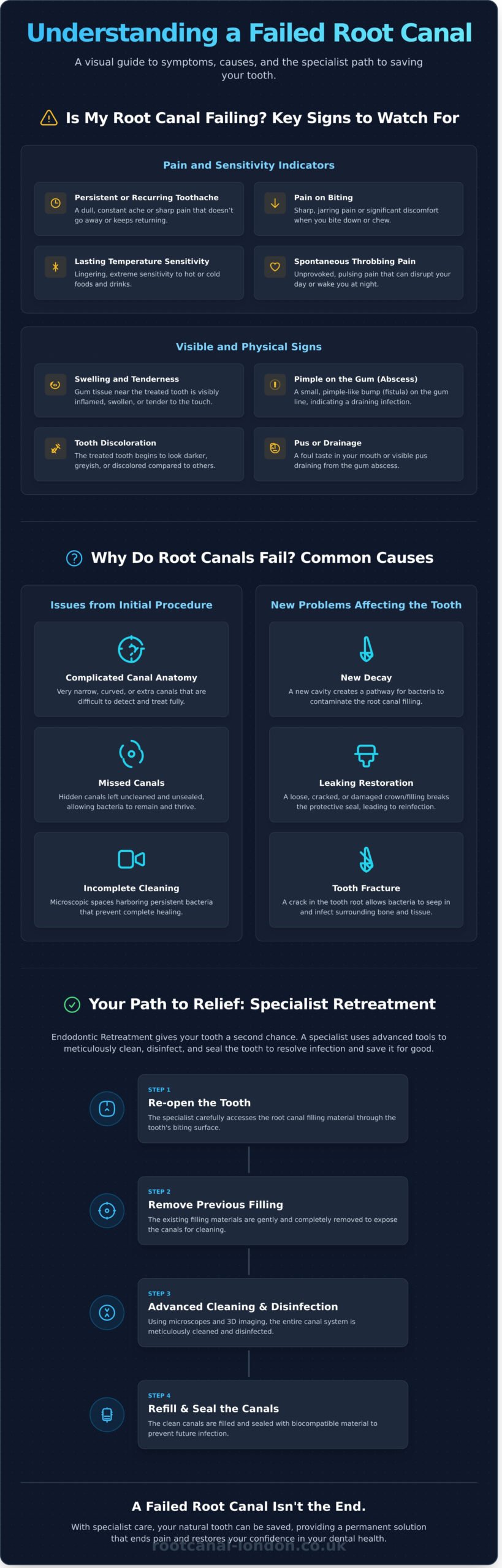
- Persistent or Recurring Toothache: A dull ache or sharp pain in the treated tooth that doesn’t go away or keeps coming back.
- Pain on Biting: Discomfort or a sharp, jarring pain when you bite down or chew with the treated tooth.
- Lasting Temperature Sensitivity: Extreme or lingering sensitivity to hot or cold foods and drinks.
- Spontaneous Throbbing Pain: Unprovoked, pulsing pain that can disrupt your day or wake you up at night.
Visible and Physical Signs
Beyond pain, there are physical signs you can see or feel around the treated tooth. These often point to an underlying infection that needs immediate care from a specialist.
- Swelling and Tenderness: The gum tissue near the treated tooth may become swollen, tender to the touch, or visibly inflamed.
- A Pimple on the Gum: The appearance of a small, pimple-like bump (known as an abscess or fistula) on the gum line is a classic sign of infection.
- Tooth Discoloration: The treated tooth may begin to look darker, greyish, or discoloured compared to your other teeth.
- Pus or Drainage: You may notice a foul taste in your mouth or visible pus draining from the gum abscess near the tooth.
Why Do Root Canals Fail? Understanding the Common Causes
If you suspect you have a failed root canal, it’s completely understandable to feel disheartened and worried. The first and most important thing to know is that this is not your fault. A root canal may fail for reasons that have little to do with the quality of the initial work, and everything to do with complex tooth anatomy or new dental problems. Understanding why it happened is the first step towards finding a calm, effective solution and achieving lasting relief.
At our London clinic, we find that the causes of root canal failure generally fall into two main categories. A specialist endodontist is equipped with advanced, specialised tools to accurately identify the source of the issue and provide caring, precise treatment.
Issues from the Initial Procedure
Sometimes, the intricate structure of a tooth’s root system presents challenges that are difficult to address in a general setting. These are not mistakes, but rather complexities that require specialist care.
- Complicated Canal Anatomy: Your tooth may have had very narrow, curved, or extra canals that were not detected on standard X-rays.
- Missed Canals: If one of these hidden canals was not cleaned and sealed, bacteria can remain and cause a new infection.
- Incomplete Cleaning: In some cases, microscopic spaces within the root canal system can harbour persistent bacteria, preventing the tooth from healing completely.
New Problems Affecting the Treated Tooth
A root canal can be successful for years, only for a new problem to allow bacteria to re-enter the tooth. This is often why pain or symptoms can return long after your original treatment.
- New Decay: A new cavity can form on the tooth, creating a pathway for bacteria to reach and contaminate the root canal filling material.
- Leaking Restoration: If the crown or filling placed on top of the treated tooth becomes loose, cracked, or damaged, it can break the protective seal and lead to reinfection.
- Tooth Fracture: A crack or fracture in the tooth root can develop over time, allowing bacteria to seep in and infect the surrounding bone and tissue.
Pinpointing the exact reason for the failure is crucial. An endodontist uses tools like 3D CBCT scanning and high-powered microscopes to see what was previously hidden. This detailed diagnosis allows us to plan the most appropriate care, which often involves a specialist endodontic retreatment designed to gently clean the canals, resolve the infection, and save your natural tooth for good.
Your Path to Relief: Specialist Treatment Options for a Failed Root Canal
Discovering you may have a failed root canal can be disheartening, but please be reassured that there is a clear path back to comfort and health. Our primary goal is always to save your natural tooth whenever possible. An endodontist, a specialist in root canal therapy, will use advanced imaging to precisely diagnose the cause of the problem. From there, we can create a calm and caring treatment plan tailored to you. Modern techniques ensure these procedures are not only highly effective but also a comfortable, stress-free experience.
Option 1: Endodontic Retreatment (The Most Common Solution)
For most cases of a failed root canal, the preferred first step is endodontic retreatment. Think of this as a second chance for your tooth. The procedure involves carefully reopening the tooth, removing the previous filling materials, and then thoroughly cleaning and disinfecting the canal system. This process, often detailed in resources on Root Canal Retreatment, allows us to address any missed canals or new infection. Once meticulously cleaned, the canals are refilled and sealed to prevent future problems. When performed by a specialist, success rates are very high, offering lasting relief.
Option 2: Apicoectomy (Endodontic Surgery)
In some situations, retreatment may not be the best option, or an infection may persist at the very tip of the root. In these cases, an apicoectomy is a highly effective, minor surgical procedure. Your endodontist will access the root tip through the gum, remove the small, infected portion of the root, and seal the end. This precise treatment addresses the infection directly at its source, allowing the bone around your tooth to heal properly. It is an excellent way to save a tooth that might otherwise be lost.
Option 3: Tooth Extraction
We view tooth extraction as the final option, reserved only for when a tooth cannot be saved. This may be necessary if the tooth has a severe fracture, extensive decay, or lacks the healthy structure needed for a successful restoration. If extraction is the only viable path, we will compassionately guide you through the process and discuss outstanding replacement options. Modern solutions like dental implants and bridges can fully restore the function and appearance of your smile, ensuring your long-term oral health.
The Retreatment Process: A Gentle, Step-by-Step Guide
We understand that the thought of re-treating a failed root canal can be daunting. Please be reassured, our primary goal is your complete comfort and a successful, lasting outcome. The retreatment process is often more straightforward than you might imagine, and while similar to your initial treatment, it is performed with the specialist precision of our endodontist, Dr. Millie.
Using advanced surgical microscopes, she can see deep inside the complex canal system, identifying and addressing the root cause of the problem. We will ensure you are fully numb and at ease throughout the entire procedure, providing a calm and pain-free experience.
Step 1: Consultation and Advanced Diagnosis
Your journey to relief begins with a calm, thorough consultation. We will carefully examine the tooth and surrounding gums, listening to your concerns. To gain a complete picture, Dr. Millie uses a state-of-the-art 3D CBCT scan. This powerful imaging allows us to see your tooth’s intricate anatomy in detail, often revealing tiny, hidden canals or issues that were missed in the initial treatment. From there, we will discuss your options and create a personalised treatment plan tailored just for you.
Step 2: Accessing and Cleaning the Canals
Once you are comfortable and completely numb, Dr. Millie will gently reopen the tooth to access the root canals. The previous filling material is carefully removed. This is where specialist care truly shines. Under high magnification from the microscope, every canal is located and meticulously cleaned of any remaining bacteria or infected tissue. We then use special antibacterial irrigants to fully disinfect the entire system, ensuring it is perfectly clean for a successful result.
Step 3: Sealing and Restoring the Tooth
With the infection removed and the canals thoroughly cleaned, the final step is to seal the tooth against future problems. We fill the canals with a new, biocompatible material to create a tight, protective seal. A secure temporary filling is then placed to protect the tooth while it heals. We will coordinate with your general dentist, who will place a permanent crown to restore the tooth’s full strength and function, completing your care seamlessly.
If you are experiencing symptoms of a dental issue, don’t wait in discomfort. Contact our caring team today to schedule your consultation and find lasting relief.
Why You Need a Specialist Endodontist for a Failed Root Canal
When a root canal doesn’t heal as expected, the path forward can seem uncertain and distressing. A failed root canal is a complex dental problem that requires a level of care beyond the scope of general dentistry. To give your tooth the very best chance of survival, seeking treatment from a specialist endodontist is not just a recommendation-it’s essential for a successful outcome.
Endodontists are dentists who have completed years of additional, intensive training focused solely on diagnosing and treating problems inside the tooth. They handle complex cases with precision and compassion every single day, significantly increasing the likelihood of saving your natural tooth.
Unmatched Expertise and Experience
While general dentists perform a wide range of procedures, an endodontist’s practice is exclusively dedicated to root canal therapy and related treatments. This singular focus hones their skills to an exceptional level. Our specialist, Dr. Millie, holds a Masters in Endodontistry from the world-renowned Eastman Dental Institute, placing her at the forefront of her field. This specialised expertise leads to significantly higher success rates, particularly in complex retreatment cases.
Advanced Technology for Precision Care
A specialist’s toolkit is far more advanced than what you’ll find in a typical dental practice. At Bespoke Dental Fulham, we use cutting-edge technology to ensure the most accurate diagnosis and effective treatment possible. This includes:
- Surgical Operating Microscopes: To magnify the tooth’s interior, revealing tiny, hidden canals that could be missed by the naked eye.
- 3D CBCT Imaging: This powerful scan provides a complete, three-dimensional view of your tooth’s anatomy, helping us to pinpoint the exact source of the problem.
- Ultrasonic Instruments: For cleaning the root canals with exceptional precision, effectively removing infection while preserving healthy tooth structure.
Focus on Pain Management and Comfort
We understand that the thought of another dental procedure can cause anxiety, especially after a previous treatment has failed. Our priority is your comfort. Endodontists are experts in profound anaesthesia, ensuring your experience is genuinely pain-free. Dr. Millie is known for her wonderfully calming and reassuring approach, helping to ease any dental fear you may have. We are here to provide relief, not add to your stress.
Don’t endure the pain and uncertainty. Book a consultation with our specialist today.
Find Lasting Relief and Peace of Mind
Recognising the signs of a potential problem, such as persistent pain or swelling, is the crucial first step towards healing. Remember, a suspected failed root canal does not mean you will lose your tooth. With an expert approach, specialist retreatment is a highly effective and predictable way to resolve the issue, save your natural tooth, and end your discomfort for good.
At Root Canal London, your comfort and well-being are our highest priority. Dr. Millie, our Specialist Endodontist with a Masters in Endodontistry, uses advanced 3D CBCT scanning and surgical microscopes to deliver precise, gentle treatment. This commitment to compassionate, expert care is why hundreds of patients have left 5-star reviews praising our reassuring and pain-free approach.
You don’t have to endure the uncertainty and pain any longer. Take the first step towards a calm, comfortable, and lasting solution. Experiencing pain? Get a specialist opinion and find lasting relief. Let us help you get back to feeling like yourself again.
Frequently Asked Questions About Failed Root Canals
Is root canal retreatment more painful than the first one?
We understand this is a common worry, but our primary goal is your comfort. With modern techniques and effective local anaesthetic, root canal retreatment should feel no different than the original procedure. Our specialist endodontist ensures you are completely numb and comfortable throughout. The procedure is designed to relieve the pain caused by the infection, providing you with lasting relief and a stress-free experience in our calm and caring environment.
How long does endodontic retreatment take?
Endodontic retreatment is often more complex than the initial procedure and requires meticulous, precise care. A single appointment typically lasts between 90 minutes and two hours. Depending on the complexity of your tooth’s canal system and the nature of the infection, your treatment may be completed in one or two visits. We will always discuss the expected timeline with you during your initial consultation so you know exactly what to expect.
What is the recovery like after a failed root canal is retreated?
Recovery after retreatment is usually straightforward. It’s normal to experience some mild tenderness or sensitivity in the area for a few days, which can be easily managed with over-the-counter painkillers like paracetamol or ibuprofen. Most patients feel comfortable returning to their normal activities the very next day. We provide comprehensive aftercare instructions to ensure your recovery is as smooth and comfortable as possible after treating your failed root canal.
How much does it cost to fix a failed root canal in London?
The cost for root canal retreatment in London varies depending on the complexity of the case and which tooth is affected (e.g., a molar is more complex than a front tooth). At a specialist practice, prices typically start from around £950 for an anterior tooth and can range up to £1,500 or more for a complex molar. We provide a clear, itemised treatment plan after your initial consultation, ensuring complete transparency with no hidden fees.
What are the success rates for root canal retreatment?
When performed by a skilled endodontic specialist using advanced technology like a surgical microscope, root canal retreatment has a very high success rate, typically between 75% and 90%. This procedure is an outstanding way to resolve infection and save your natural tooth, which is always our preferred outcome. The specific prognosis for your tooth will be discussed with you during your consultation, giving you confidence in your treatment plan.
Can a failed root canal make you sick?
A failed root canal harbours a persistent bacterial infection within your tooth. If left untreated, this infection can spread to the surrounding jawbone, leading to a painful abscess. While it is rare for this localised dental infection to cause a serious systemic illness in a healthy individual, it can certainly cause symptoms like facial swelling, fever, and a general feeling of being unwell. Prompt treatment is essential to eliminate the infection and protect your overall health.
How long can a failed root canal go untreated?
It is never advisable to leave a failed root canal untreated. Even if it isn’t causing severe pain, the underlying infection can quietly cause progressive damage to the bone surrounding your tooth root. Over time, this can make the tooth unsavable. We strongly recommend seeking an expert evaluation as soon as you suspect an issue. Addressing the problem promptly provides the best chance of saving your tooth and preventing more complex problems later on.