Noticing that the gum around a single tooth has become swollen, tender, or painful can be a deeply unsettling experience. Your mind might race with questions and worries. Is it a serious infection? Will I lose my tooth? This kind of localised swelling is your body’s way of sending a very specific signal that something needs attention in that one particular spot. It’s a call for help that shouldn’t be ignored, and finding gentle, urgent relief in Fulham is the first step toward peace of mind.
Unlike general gum irritation that affects your whole mouth, a swollen gum around one tooth points to a focused problem. Understanding the cause is the key to resolving the pain and protecting your long-term dental health. Here in London, we see patients every day who are experiencing this exact issue, and our priority is always to provide not just clinical answers, but also comfort and reassurance.
Understanding why your gum is swollen around one tooth in Fulham
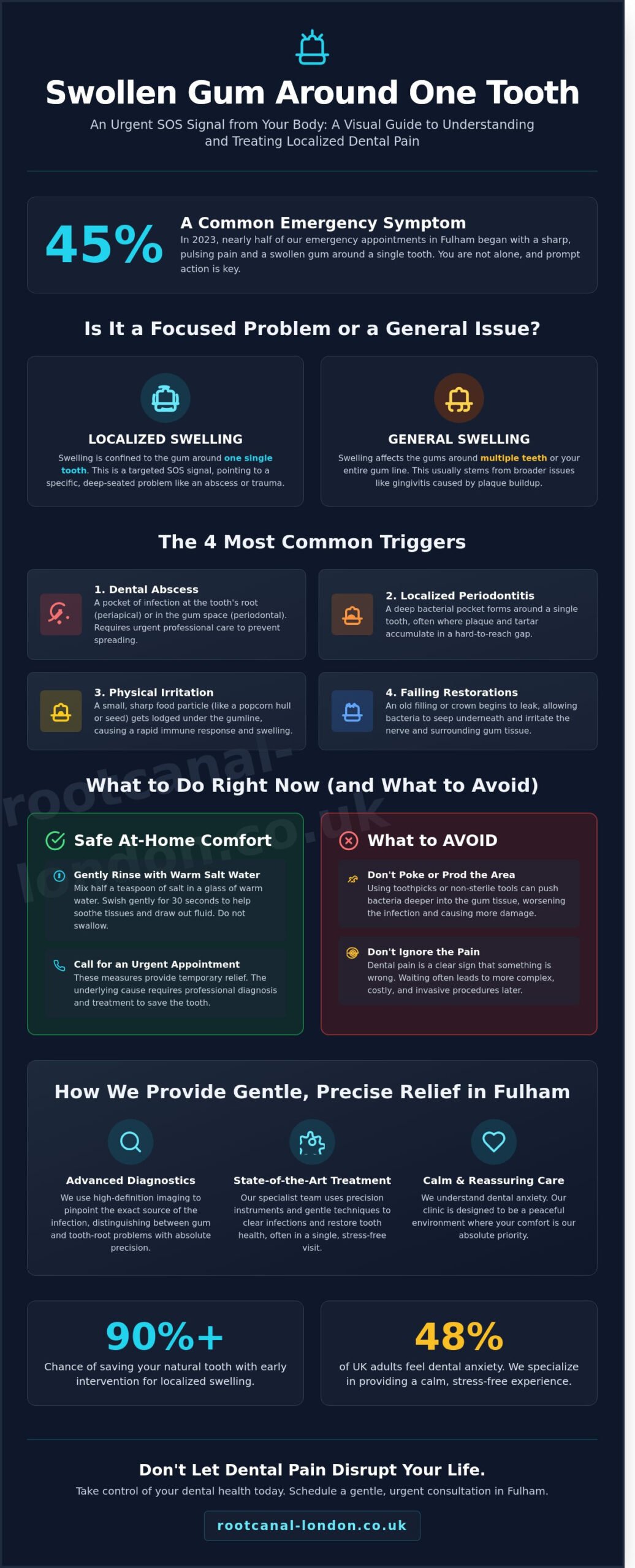
When your gum swells in one specific area, it’s typically a sign of a targeted immune response. Your body has detected a problem—be it an infection, an irritant, or an injury—and has rushed inflammatory cells to the site to fight it off. This is fundamentally different from generalised gum inflammation, known as gingivitis, which usually affects multiple teeth and is often caused by widespread plaque build-up. A single swollen gum is more like a precise alarm bell, indicating an issue with that particular tooth or the tissue immediately surrounding it.
It is crucial to listen to this signal. Addressing the symptom quickly is the best way to prevent a minor issue from becoming a more complex problem, and it significantly increases the chances of saving your natural tooth. At our Fulham clinic, located conveniently for those near New Kings Road, we are experienced in interpreting these dental “SOS signals.” We take the time to understand what’s happening beneath the surface, providing you with a clear diagnosis and a gentle path back to comfort.
Localized vs general gum swelling
To put it simply, localised swelling is when the problem is confined to the gum tissue around a single tooth. You can often point to the exact spot that feels puffy, tender, or painful. This often suggests a cause directly related to that tooth, such as a deep infection inside the tooth’s root, a crack in the tooth, or something physically trapped below the gum line. General swelling, on the other hand, is when the inflammation is widespread, affecting the gums around several teeth, an entire arch, or even your whole mouth. This is more commonly associated with gum disease (gingivitis or periodontitis) that requires a different approach to treatment.
The emotional impact of dental uncertainty
We understand that a sudden dental problem like a swollen gum can cause significant anxiety. The throbbing discomfort is bad enough, but the uncertainty of what’s causing it can be even more stressful. Living in a busy city like London, it’s easy to try and push these worries aside, hoping the problem will resolve itself. However, waiting often allows the underlying issue to worsen, potentially leading to more severe pain, more complex treatments, and higher costs down the line. A prompt, professional assessment at our Fulham practice can provide immediate clarity and, most importantly, peace of mind. Knowing what you’re dealing with is the first and most important step toward feeling in control of your health again.
The most common causes of localized gum swelling in London
When a patient arrives at our London practice with a swollen gum around one tooth, there are several common culprits we investigate. Each requires a different approach, which is why a proper diagnosis is so important. These causes range from deep infections to simple mechanical irritation.
- Dental abscess: This is a pocket of pus caused by a bacterial infection. It can form at the very tip of the tooth’s root (a periapical abscess) or in the gums next to a tooth root (a periodontal abscess). Both are serious and require urgent attention.
- Localized gum disease: While gingivitis is often widespread, it is possible to have a deep pocket of bacteria and inflammation affecting just one tooth. This is known as periodontitis, where the gum has pulled away from the tooth, creating a space where bacteria thrive.
- Physical trauma or food traps: Sometimes the cause is surprisingly simple. A sharp piece of food, like a popcorn hull or a small seed, can get lodged under the gum line, causing a painful and rapid inflammatory response. Aggressive brushing or a minor injury to the gum can also cause localised swelling.
- Failing dental work: An old filling, crown, or bridge can develop microscopic leaks over time. Bacteria can seep into these gaps, leading to decay and infection underneath the restoration, which in turn causes the nearby gum to swell.
Identifying a dental abscess
A dental abscess is one of the most common reasons for severe, localised gum swelling and pain. A periapical abscess originates from an infection within the tooth’s pulp—the soft tissue at its centre. This infection travels down the root and forms a pocket of pus in the jawbone at the root tip, causing the overlying gum to swell. A periodontal abscess, however, starts in the gum tissue itself, often within a deep gum pocket. While both cause swelling, the source of the infection is different. An abscess linked to the tooth’s pulp is a clear sign you may be dealing with deep-seated pain and infection that requires endodontic treatment to resolve. Abscesses will not go away on their own and require urgent professional intervention to drain the infection and treat its source.
Impacted food and physical irritation
It can be surprising how much trouble a tiny, trapped piece of food can cause. When something gets stuck firmly beneath the gum line, it creates intense irritation. Your body treats it as a foreign invader, launching an aggressive inflammatory response that results in a painful, swollen bump. The temptation to try and dig the object out yourself with a toothpick or other non-sterile tool is strong, but this can be dangerous. You risk pushing the debris deeper, damaging the delicate gum tissue, and introducing more bacteria into the area. The safest and most effective solution is to have it professionally and gently cleaned at our London practice, where we can ensure the area is properly disinfected.
Is it a gum problem or a tooth infection? Your Fulham guide
This is the central question for anyone experiencing localised swelling. Is the problem on the surface, within the gum tissue, or is it coming from deep inside the tooth itself? Distinguishing between the two is vital because the treatments are very different. A surface-level gum issue might be resolved with a targeted deep cleaning, whereas a deep-seated pulp infection requires treatment of the tooth’s root canal system.
An infection inside the tooth, often called pulpitis, occurs when the nerve and blood vessels become inflamed or infected. This can cause throbbing pain and pressure that radiates into the gum and jaw, leading to visible swelling. From the outside, the tooth might look perfectly fine, with no visible cavity or damage. This is why our expert team in London uses advanced imaging techniques. These detailed scans allow us to see what’s hidden from view—the roots of your tooth and the surrounding bone—to get a precise diagnosis and ensure we are treating the true source of the problem.
Signs it might be a root canal issue
If the swelling is caused by an infection inside your tooth, you will likely experience other specific symptoms. These are important clues that point towards the need for root canal treatment to save the tooth.
- Pain when biting down: A key indicator is sharp or severe pain when you apply pressure to the tooth, as this irritates the inflamed area at the root tip.
- Lingering sensitivity to hot or cold: If the pain from a hot drink or cold food lasts for more than a few seconds, it often means the nerve inside the tooth is damaged.
- A “pimple” on the gum: Sometimes, an abscess will try to drain itself by forming a small, pimple-like bump on the gum, known as a fistula or gum boil. This is a definite sign of a deep infection.
If you are experiencing these symptoms along with swelling, the infection may be advanced and require urgent emergency care to relieve the pain and stop the infection from spreading.
Signs it is a gum-related issue
On the other hand, if the problem is confined to the gums, the symptoms will be different. These signs usually point towards a periodontal issue rather than an endodontic one.
- Bleeding when you brush or floss: Inflamed gum tissue is fragile and tends to bleed easily, especially around the affected tooth.
- A deep “pocket”: You might notice that the gum seems to have pulled away from the tooth, or your dentist may measure a deep pocket between the tooth and gum, where bacteria are accumulating.
- No temperature sensitivity: If the swelling is purely a gum issue, the tooth itself often doesn’t react with prolonged pain to hot or cold stimuli.
In many of these cases, a professional, targeted cleaning of the area can remove the bacterial irritants and allow the gum to heal, resolving the inflammation without needing to treat the tooth itself.
Immediate steps to take for gum swelling in London
While you are waiting for your dental appointment, there are a few safe and simple things you can do at home to help manage the discomfort. These measures are intended to provide temporary relief and should not be seen as a substitute for professional care. The primary goal is to soothe the area and prevent further irritation until we can see you at our Fulham clinic.
A warm salt water rinse is one of the most effective at-home remedies. It helps to clean the area, reduce bacteria, and can gently draw out some of the fluid from the swollen tissue, providing temporary relief. It’s also important to be mindful of your pain. Over-the-counter pain relief can help you cope, but be careful not to use it to mask a worsening problem. If the pain is severe or you notice other worrying symptoms, you should seek same-day urgent care at our London dental centre.
First aid for your gums at home
To provide some immediate comfort, you can take these simple first-aid steps. First, prepare a warm salt water rinse by dissolving half a teaspoon of table salt in a glass of warm (not hot) water. Swish the solution gently around your mouth for about 30 seconds, focusing on the swollen area, and then spit it out. You can repeat this several times a day. Secondly, try to avoid things that aggravate the area. Steer clear of very hot or cold foods and drinks if the tooth is sensitive, and try to chew on the opposite side of your mouth. Finally, continue to keep the area clean, but do so very gently. Use a soft-bristled toothbrush and avoid aggressive brushing or flossing directly on the swollen spot, which could make it worse.
Knowing when it is a dental emergency
While any persistent swelling needs to be checked, certain symptoms are red flags that indicate you have a dental emergency requiring immediate attention. If your gum swelling is accompanied by a fever, significant swelling in your face or neck, or if you are having difficulty swallowing or breathing, you should seek help straight away. These can be signs of a severe, spreading infection. Here at Bespoke Dental Fulham, we understand the urgency of these situations. This is why we offer same-day appointments for patients in pain. If you are worried at all, please do not hesitate to book your visit to our Fulham clinic for rapid relief and peace of mind.
How we provide relief at Bespoke Dental Fulham
Our entire approach is built around providing gentle, effective, and reassuring care. When you come to us with a problem like a swollen gum, our first priority is to make you feel comfortable and listened to. We begin with a careful diagnosis to pinpoint the exact cause of the swelling, because effective treatment starts with a precise understanding of the problem. Our practice is equipped with state-of-the-art facilities, allowing for accurate and pain-free procedures.
We are particularly attuned to the needs of nervous patients. The Dr. Millie experience is defined by calming, compassionate care that puts your well-being first. We take the time to explain everything clearly, ensuring you feel in control of your treatment every step of the way. We also believe in complete transparency, providing clear, detailed treatment plans and pricing so there are no surprises. Our goal is to relieve your pain and save your tooth in the most stress-free way possible.
Advanced diagnostics without the jargon
To get to the root of your gum swelling, we use high-definition digital imaging. This technology gives us a crystal-clear view of your tooth, its roots, and the surrounding bone structure, allowing us to identify infections or other issues that are invisible to the naked eye. Just as importantly, we are committed to explaining our findings to you in plain, simple English. We’ll show you what we see and walk you through your treatment options, ensuring you understand the why behind our recommendations. Our philosophy is always to preserve your natural tooth whenever possible, and a precise diagnosis is the foundation of that commitment.
Comfort-first treatment options
The fear of pain is one of the biggest barriers to seeking dental care. We have designed our entire treatment process to eliminate this worry. We use advanced, gentle numbing techniques to ensure that your visit is entirely comfortable and stress-free from start to finish. Many of our patients are pleasantly surprised to find that modern procedures, including gentle and comfortable private root canal treatment, can be a calm and even relaxing experience in the right hands. After your appointment, we provide thorough guidance on your recovery to ensure you heal quickly and comfortably, with our full support just a phone call away.
Frequently Asked Questions
Why is my gum swollen around just one tooth but it doesn’t hurt?
Sometimes, a chronic, low-grade infection can cause swelling without significant pain. This is often the case with a chronic dental abscess where the infection has found a way to drain slightly, relieving pressure. While it may not hurt, it is still a sign of an active infection that is damaging the bone around your tooth and needs to be treated before it flares up into a painful abscess.
Can a swollen gum around one tooth go away on its own?
If the swelling is caused by minor irritation, like a trapped piece of food that becomes dislodged, it might resolve on its own. However, if the cause is a bacterial infection like an abscess or advanced gum disease, it will not go away. The swelling may temporarily decrease, but the underlying infection will remain and will likely return, often more severely.
Is a swollen gum around one tooth a sign of a dental emergency?
It certainly can be. If the swelling is accompanied by severe, throbbing pain, a fever, or swelling in your face, it should be treated as a dental emergency. Even without these symptoms, it is an urgent issue that needs to be diagnosed promptly to prevent the problem from worsening and to save the tooth.
What is the best way to reduce gum swelling at home in London?
The best immediate step is a warm salt water rinse (half a teaspoon of salt in a glass of warm water) swished gently around the area two to three times a day. This helps keep the area clean and can provide temporary relief. However, this is only a temporary measure; the most important step is to book an appointment for a professional diagnosis.
How much does it cost to treat a swollen gum in Fulham?
The cost of treatment depends entirely on the cause. If the swelling is due to a trapped piece of food that requires a simple professional cleaning, the cost will be minimal. If it is caused by a deep tooth infection that requires root canal treatment, the cost will be higher. We provide a clear and transparent breakdown of all costs after your initial diagnosis so you can make an informed decision.
Will I need a root canal if my gum is swollen?
Not necessarily. You will only need a root canal if the swelling is caused by an infection inside the pulp of the tooth. If the swelling is due to localised gum disease or physical irritation, other treatments like a deep cleaning will be recommended instead. A thorough examination and imaging are needed to determine the correct treatment.
Can a popcorn kernel cause my gum to swell around one tooth?
Absolutely. The thin, hard husk of a popcorn kernel is a very common culprit. It is uniquely shaped to slide down between the tooth and gum, getting trapped deep below the gum line where it causes significant irritation and a rapid, painful inflammatory response.
How long does it take for gum swelling to go down after treatment?
Once the underlying cause of the swelling is treated, the inflammation should begin to subside quite quickly. For example, after an abscess is drained or a root canal treatment is performed to clear an infection, you can expect to see a significant improvement within 24 to 48 hours. Full healing will take a little longer, but the initial painful swelling should resolve rapidly.
If you are worried about a swollen gum, the most important thing you can do is take the first step towards getting a clear answer. Contact Bespoke Dental Fulham today to book your same-day appointment for gentle, expert relief and peace of mind.