

That sudden, tender puffiness next to just one tooth can be unsettling, if not outright alarming. When you notice a swollen gum around one tooth, your mind can race with questions and concerns. Is it a sign of a serious infection? Will it resolve on its own? Could you be at risk of losing the tooth? We understand this anxiety completely. These are important questions, and seeking clear, professional advice is the right first step to take.
In this specialist guide, we will provide the calm, caring answers you need. We’ll gently walk you through the common-and the more serious-causes behind localised gum swelling. You will learn practical steps you can take at home for immediate comfort and, crucially, gain a clear understanding of the specific symptoms that signal a dental emergency. Our goal is to ease your concerns, empower you with knowledge, and help you feel back in control of your dental health.
Key Takeaways
- A swollen gum around one tooth is your body’s signal of a localised issue, with a dental abscess being the most urgent cause that needs immediate professional assessment.
- Learn the critical signs that mean you must call an emergency dentist immediately, and when you can safely monitor the situation at home.
- Lasting relief comes from treating the root cause, not just the symptom. Discover the professional treatments that resolve the underlying problem for good.
- Find out why seeing a specialist Endodontist is the recommended path for complex cases, ensuring you receive expert, gentle care to save your tooth and end the pain.
Why Is Only One Gum Swollen? Common Causes Explained
Noticing a swollen gum around one tooth can be unsettling, and we understand your concern. While widespread swelling often points to a more general issue, localised puffiness is usually a clear signal that something specific is happening with that particular tooth or the gum tissue directly surrounding it. The good news is that this focus makes it easier to identify the cause.
Let’s walk through the most common reasons, from simple irritations to more complex dental problems. Understanding the potential cause is the first calm, confident step toward finding the right solution and restoring your comfort.
Simple Irritation: Trapped Food or Injury
Often, the culprit is something surprisingly simple. A tiny, sharp piece of a popcorn husk or a seed can easily get wedged between your tooth and gum, causing localised inflammation. Similarly, brushing too aggressively or accidentally catching your gum with the floss can cause minor trauma. You’ll typically notice mild tenderness and redness right at the site of the irritation. In many cases, this resolves on its own within a day or two with gentle, careful cleaning.
Early Gum Disease (Gingivitis)
Gingivitis is the earliest stage of Periodontal disease, caused by a build-up of plaque along the gumline. While it can affect your whole mouth, it’s common for it to start or be more noticeable in one specific area where plaque has accumulated. This inflammation is your body’s response to the bacteria. Key signs include redness, swelling, and gums that bleed when you brush. The reassuring news is that gingivitis is completely reversible with improved oral hygiene and a professional dental cleaning.
A Cracked Tooth or Failing Filling
Sometimes, the problem isn’t with the gum itself, but with the tooth it surrounds. A tiny, invisible crack in a tooth or an old filling that has started to leak can create an entry point for bacteria, leading to irritation or an infection deep within the tooth. A swollen gum around one tooth is often a visible sign of this underlying issue. This requires a professional dental assessment to diagnose accurately and determine the right, caring treatment to protect the tooth.
The Most Serious Cause: A Dental Abscess
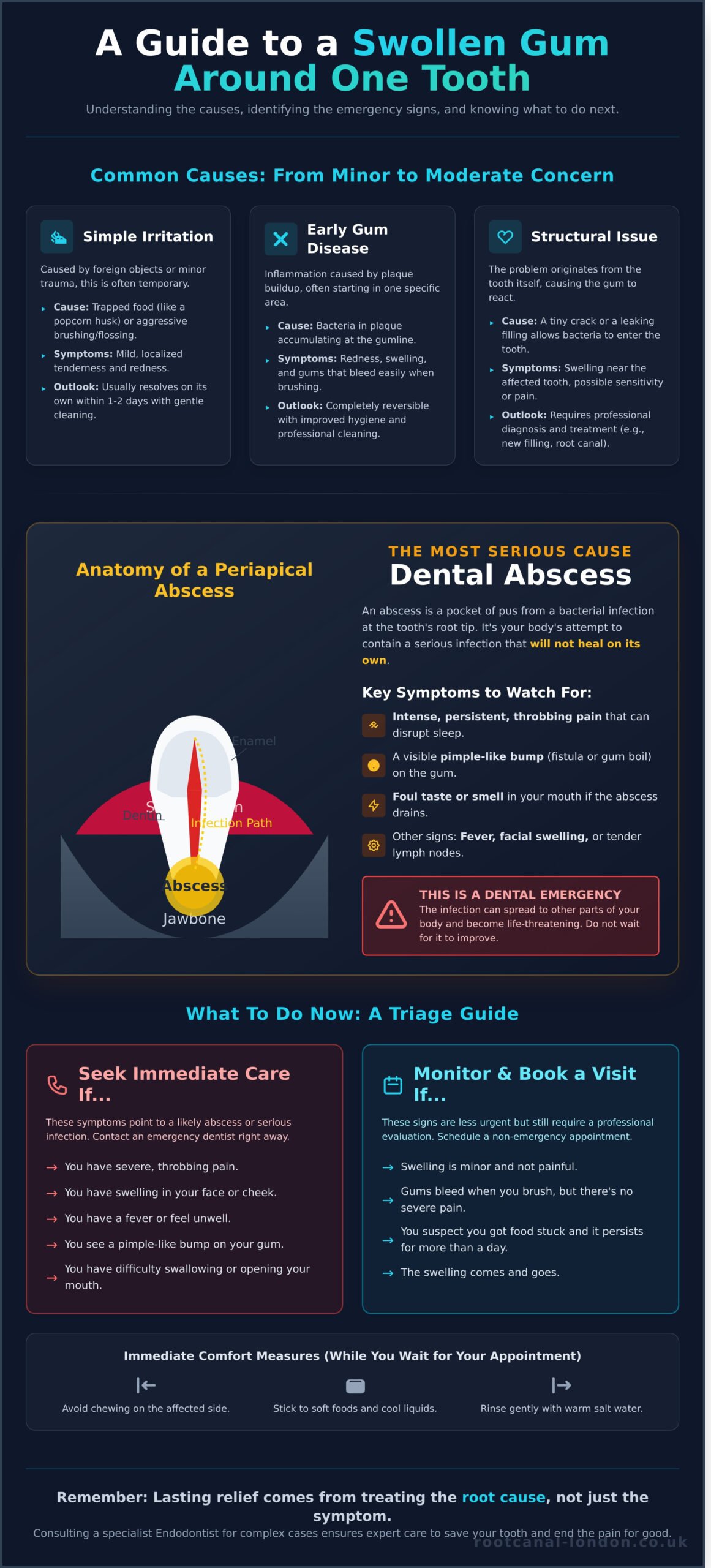
While several issues can cause a swollen gum around one tooth, the most serious and urgent cause is a dental abscess. This isn’t just minor irritation; it’s a pocket of pus that forms due to a significant bacterial infection. An abscess is the body’s way of trying to contain an infection that has taken hold deep within or around your tooth. It is a clear and urgent signal that you need to see a dentist immediately, as this condition will not heal on its own and requires professional, caring treatment to resolve.
What is a Periapical Abscess?
A periapical abscess is a specific type of infection that forms at the very tip of a tooth’s root. This typically happens when tooth decay becomes so advanced that it breaches the outer enamel and dentin, allowing bacteria to infect the tooth’s inner pulp-the soft tissue containing nerves and blood vessels. According to the National Institutes of Health, a dental abscess is a localized collection of pus. From the pulp, the infection travels down the root canal and exits at the root tip, spreading into the surrounding jawbone and causing the localised, painful swelling you feel in your gum. This is a primary reason why skilled root canal treatment is often necessary to save the tooth.
Key Symptoms of a Dental Abscess
If your swollen gum is caused by an abscess, you will likely experience other distinct and uncomfortable symptoms. We understand how distressing these can be, and recognising them is the first step toward getting relief. Look for:
- Intense, persistent pain: Often described as a severe, throbbing toothache that can be strong enough to wake you up at night.
- A pimple on the gum: A small, raised bump (called a fistula or gum boil) may appear on the gum near the painful tooth.
- A foul taste or smell: You might notice an unpleasant, salty taste or bad breath if the abscess begins to drain pus.
- Other warning signs: In more severe cases, you may also have pain when biting, swelling in your face or cheek, a fever, or tender lymph nodes in your neck.
Why an Abscess is a Dental Emergency
A dental abscess is more than just a tooth problem; it is a serious health risk that requires immediate attention. This is not a ‘wait and see’ situation. The infection responsible for a swollen gum around one tooth can spread from the jaw to other parts of your body, including your neck or even, in rare cases, your brain. Left untreated, it can lead to a systemic illness. Prompt, expert treatment is essential not only to provide immediate pain relief but also to save your natural tooth and prevent life-threatening complications. Your health and comfort are our priority.
What To Do Now: A Triage Guide for Your Swollen Gum
Discovering a swollen gum around one tooth can be alarming. Your immediate priority is to manage the discomfort and understand when to seek professional care. While home remedies can provide temporary relief, they are not a substitute for a proper dental diagnosis. This guide will help you take the right steps to protect your oral health and find lasting relief.
Immediate Steps for Temporary Relief
If your symptoms are mild, you can take these steps at home to soothe the area while you arrange a dental appointment. Remember, these actions are for comfort and do not cure the underlying problem.
- Warm Salt Water Rinse: Gently swish a solution of half a teaspoon of salt in a glass of warm water around your mouth for 30 seconds, then spit it out. This can help reduce inflammation and clean the area.
- Avoid Chewing on the Affected Side: Give the sensitive area a rest by chewing on the opposite side of your mouth to prevent further irritation.
- Maintain Gentle Oral Hygiene: It’s vital to keep the area clean, but do so gently. A build-up of plaque is a common cause of gingivitis, which can lead to localised swelling. Brush and floss carefully around the affected tooth.
- Over-the-Counter Pain Relief: Painkillers such as paracetamol or ibuprofen (if suitable for you) can help manage discomfort effectively.
Red Flag Symptoms: See an Emergency Dentist Today
Some symptoms indicate a more serious issue, such as an abscess, that requires immediate professional attention. Please contact us for an emergency appointment without delay if you experience any of the following:
- Severe, throbbing pain that isn’t relieved by standard painkillers.
- Swelling that has spread to your face, jaw, or down your neck.
- Difficulty breathing or swallowing.
- A high temperature (fever) or a general feeling of being unwell.
What to Expect at Your Emergency Appointment
We understand that you are in pain and feeling anxious. Our priority is your comfort and well-being. During your appointment, we will take a calm and caring approach to resolve your swollen gum around one tooth.
- A Gentle Examination: We will carefully examine the tooth and surrounding gum to identify the source of the swelling.
- Diagnostic X-ray: An X-ray is usually necessary to see what is happening beneath the gum line, at the root of the tooth.
- Diagnosis and Pain Relief: We will diagnose the cause and, most importantly, take immediate steps to relieve your pain.
- A Clear Treatment Plan: You will leave our clinic with a clear understanding of the problem and a detailed plan for the necessary treatment.
Professional Treatments to Resolve a Swollen Gum
The right treatment for a swollen gum around one tooth depends entirely on the underlying cause. Our first priority is to provide an accurate diagnosis so we can focus on eliminating the source of the inflammation, not just the symptom. We understand that dental procedures can be a source of anxiety, which is why we are committed to making your experience as comfortable and stress-free as possible. Our ultimate goal is always to provide lasting relief and save your natural tooth whenever we can.
Deep Cleaning (Scaling and Root Planing)
If localised gum disease (gingivitis or periodontitis) is the culprit, the most effective treatment is often a deep cleaning, also known as scaling and root planing. This is a non-surgical procedure where we carefully remove stubborn plaque and tartar from above and below the gumline. By cleaning the tooth’s root surfaces, we create a healthy environment for your gum tissue to heal, reduce swelling, and reattach firmly to the tooth.
Root Canal Treatment: Saving an Infected Tooth
When the swelling is caused by a dental abscess-an infection deep inside the tooth’s pulp-a root canal is the definitive treatment. This skilled procedure involves removing the infected and inflamed pulp, thoroughly cleaning and disinfecting the internal canals, and then sealing the tooth to prevent re-infection. A root canal doesn’t just treat the swollen gum; it eliminates the infection at its source, providing profound pain relief.
Why You Shouldn’t Fear a Root Canal
The myth that root canals are painful is one of modern dentistry’s most persistent misunderstandings. The reality is the exact opposite: a root canal is a pain-relieving procedure. The discomfort comes from the infection, not the treatment designed to cure it.
- It’s a relief, not a pain. The procedure removes the source of your agony.
- Your comfort is our priority. We use effective local anaesthetic to ensure a calm and pain-free experience.
- It saves your tooth. A root canal is the best way to save a natural tooth that would otherwise need to be extracted.
In pain? Don’t wait. Book an emergency appointment today at Bespoke Dental Fulham.
How Our Specialist Endodontist Provides Expert, Gentle Care
When you’re dealing with the pain and worry of a swollen gum, you deserve care that is not only highly effective but also gentle and reassuring. A general dentist can handle many issues, but when the problem originates deep inside the tooth, a specialist’s touch is required. An Endodontist is a root canal specialist, a dentist who has completed years of advanced training focused exclusively on diagnosing tooth pain and saving natural teeth.
At Root Canal London, our specialist, Dr. Millie, combines this advanced expertise with a deeply compassionate approach, ensuring your experience is as comfortable and stress-free as possible.
The Specialist Advantage
An Endodontist’s focused training provides a significant advantage. We are experts at diagnosing complex dental pain, pinpointing the exact cause of symptoms like a persistent swollen gum around one tooth. Because we perform root canal treatments and retreatments every day, we are uniquely equipped to handle challenging cases, such as teeth with narrow or curved canals, ensuring the highest possible success rate for your treatment.
Advanced Technology for Precise Treatment
To achieve outstanding results, we use state-of-the-art technology that allows for incredible precision. This ensures that the source of the infection is completely and thoroughly removed.
- Surgical Operating Microscopes: These powerful microscopes allow Dr. Millie to see the intricate, tiny details inside your tooth’s root canal system, ensuring no area is missed.
- 3D CBCT Scans: A Cone Beam CT scan provides a detailed, three-dimensional view of your tooth, bone, and surrounding tissues, revealing the full extent of an infection with remarkable clarity.
A Calm and Reassuring Experience
We understand that dental emergencies are stressful, and the thought of treatment can cause anxiety. That is why our entire practice is built around your comfort. Dr. Millie is renowned for her wonderfully calming and reassuring manner, taking the time to explain every step and listen to your concerns. From the moment you call us, our team is dedicated to easing your worries and providing a gentle, pain-free experience. If you’re suffering from a swollen gum around one tooth, you are in the safest, most caring hands. Learn more about our caring approach to root canals.
Don’t Ignore a Swollen Gum: Find Lasting Relief Today
A swollen gum around one tooth is more than just an inconvenience; it’s a clear signal from your body that something needs professional attention. While the cause can sometimes be minor, it can also point to a serious underlying issue like a dental abscess that requires urgent care to prevent further complications. The most crucial step you can take is to seek a prompt and accurate diagnosis.
At Root Canal London, your comfort and health are our highest priorities. Our Specialist Endodontist, Dr. Millie, uses advanced technology to provide gentle, precise treatment designed to save your natural tooth. We understand that dental pain can’t wait, which is why we offer same-day emergency appointments to provide swift relief when you need it most.
Experiencing pain or swelling? Don’t wait for it to get worse. Book an emergency appointment online now. Taking this simple step is the fastest way to find peace of mind and lasting comfort. Our caring team is ready to help.
Frequently Asked Questions About Gum Swelling
Can a swollen gum around one tooth go away on its own?
While minor irritation can sometimes resolve, a persistent swollen gum around one tooth is a clear sign of an underlying issue that requires professional attention. It is your body’s warning system for problems like infection or gum disease. Hoping it will disappear on its own can allow the condition to worsen. Seeking a prompt, expert diagnosis is the safest way to protect your oral health and find lasting relief.
Is a swollen gum always a sign of an abscess?
Not always, but a dental abscess is a very common and serious cause that needs urgent care. Other issues, such as trapped food, advanced gum disease (periodontitis), or even a cracked tooth can also cause localised swelling. Because an abscess is an active infection that can spread, it’s vital not to self-diagnose. An endodontic specialist can provide a precise diagnosis and ensure you receive the appropriate, caring treatment.
How can I reduce gum swelling quickly at home before my appointment?
For temporary relief while you wait to be seen, you can gently rinse your mouth with warm salt water (half a teaspoon of salt in a glass of warm water). This can help soothe the area. Applying a cold compress to the outside of your cheek for 15-minute intervals may also help reduce inflammation. Please remember these are only for short-term comfort and are not a substitute for professional dental treatment to address the root cause.
What are the risks of ignoring a swollen gum and hoping it gets better?
We understand the temptation to wait, but ignoring swelling can have serious consequences. If caused by an infection, it can spread to the jawbone, adjacent teeth, or even enter the bloodstream, leading to a dangerous systemic illness. Delaying treatment significantly increases the risk of needing the tooth extracted. Prompt, compassionate care is the best way to prevent complications, save your tooth, and protect your overall health.
Will I need antibiotics for a swollen gum?
If the swelling is caused by a bacterial infection like an abscess, antibiotics are often a necessary first step to control the infection and reduce your pain. However, antibiotics only manage the symptoms; they do not fix the source of the problem inside the tooth. To achieve a permanent solution and prevent the infection from returning, treatment such as a root canal is typically required to clean and seal the tooth.
Does a root canal hurt more than a regular filling?
This is a common worry, and we are happy to provide reassurance. With modern techniques and effective local anaesthesia, the root canal procedure itself should be a comfortable experience, no different from having a routine filling placed. The severe pain people associate with the treatment is actually the toothache caused by the infection beforehand. Our primary goal is to relieve your pain and ensure you have a calm, stress-free experience.