
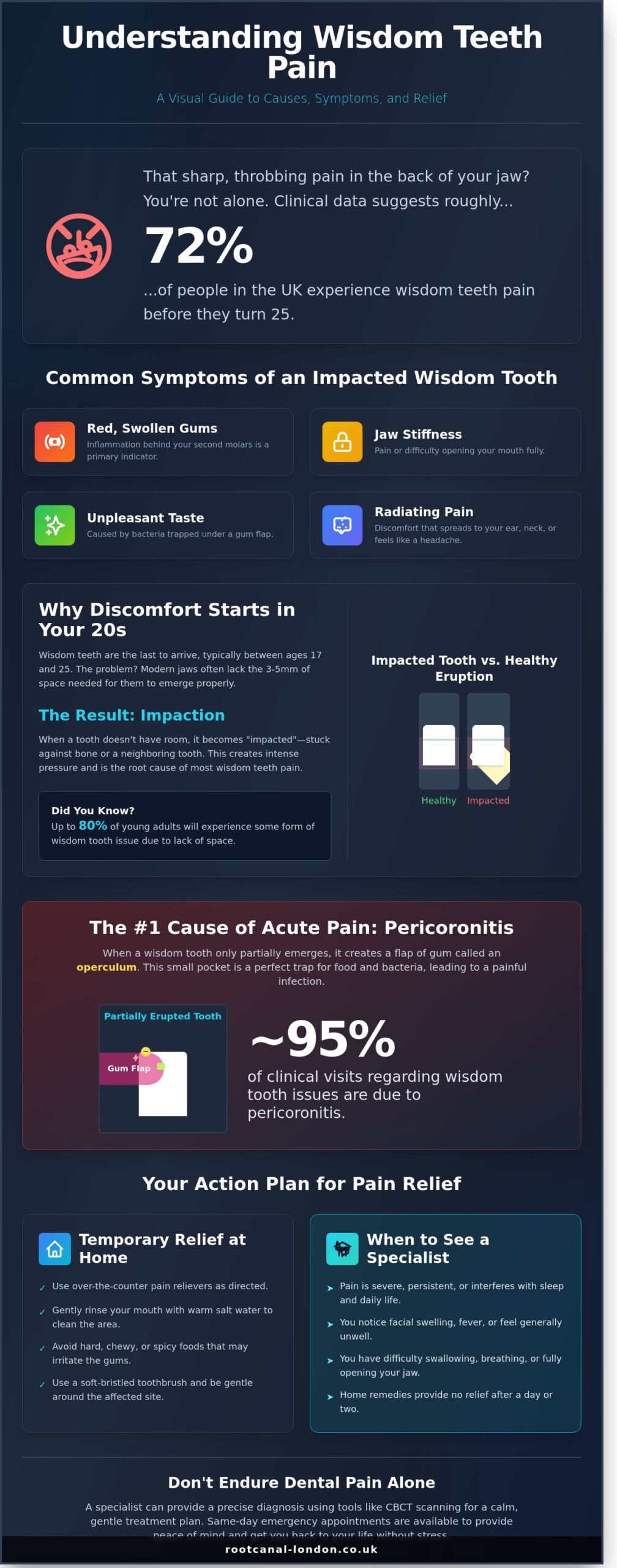
Imagine it’s 3:00 AM on a Tuesday morning, and instead of sleeping, you’re pacing your Fulham flat because a sharp, persistent throbbing in the back of your jaw simply won’t stop. You aren’t alone, as clinical data suggests roughly 72% of people in the UK experience some form of wisdom teeth pain before they reach the age of 25. We understand that this isn’t just a physical ache; it’s the exhaustion of swollen gums that make eating a chore and the underlying anxiety about whether you’ll need a complex extraction.
You deserve to feel comfortable and informed about your dental health. We agree that dental discomfort can feel overwhelming, especially when it interferes with your daily life and peace of mind. This guide will help you identify the specific causes of your discomfort, provide practical steps for finding immediate relief in London, and clarify exactly when you should seek expert care from a specialist. We’ll explore the common signs of infection and outline a calm, gentle treatment plan designed to get you back to your best without the stress.
Key Takeaways
- Learn to identify the signs of emerging third molars and why “teething” sensations often return for adults in their early twenties.
- Understand the mechanics of impaction and how trapped food can lead to painful inflammation, helping you pinpoint the source of your discomfort.
- Discover how to distinguish between wisdom teeth pain and other dental issues to ensure you receive the most effective treatment.
- Find safe, temporary home remedies and over-the-counter options available at local Fulham pharmacies to ease your pain tonight.
- Explore the calming, expert approach of Dr. Millie at Bespoke Dental Fulham for those requiring urgent dental care or emergency appointments.
Identifying Wisdom Teeth Pain and Why It Occurs in Adulthood
If you are feeling a persistent, dull ache at the very back of your jaw, you aren’t alone. This specific type of discomfort, often referred to as wisdom teeth pain, is one of the most frequent reasons patients visit our Fulham clinic. These third molars are the final set of teeth to emerge, typically arriving long after your other adult teeth have settled. While most of your permanent teeth are in place by age 13, these latecomers wait until your early twenties to make an appearance. For many adults in London, this feels like a second round of teething, often accompanied by a distinct pressure as the teeth attempt to break through the gum line.
We see these cases every single day. It is a standard part of dental development, and there is no need to feel anxious about the sensation. Whether it is a mild throb or a more sharp, localised pressure, our team focuses on providing a calm and reassuring environment to help you find relief. We understand that dental pain can be distressing, especially when it interferes with your work or sleep. Our goal is to move you from a state of painful uncertainty to confident action, ensuring you feel supported throughout the process. Identifying the cause of your discomfort is the first step toward a pain-free smile.
Common Symptoms of Impacted Wisdom Teeth
You might notice your gums looking red or swollen specifically behind your second molars. This inflammation often makes it difficult to open your jaw fully. Some patients also report a persistent unpleasant taste, which occurs when bacteria get trapped under a gum flap. It is common for Impacted wisdom teeth to cause pain that radiates toward your ear or neck, often mimicking a tension headache.
Why Wisdom Teeth Cause Discomfort in Your 20s
Biology dictates that third molars are the last to arrive, usually between the ages of 17 and 25. Research suggests that up to 80% of young adults will experience some form of wisdom tooth issue. The primary problem is space. Modern jawlines are often too narrow to accommodate these extra teeth. When there isn’t enough room, the tooth becomes “impacted,” meaning it grows at an angle or gets stuck, triggering significant wisdom teeth pain.
There is a clear difference between normal eruption and a painful infection. A healthy eruption might cause a slight tenderness for a few days as the tooth breaks the surface. However, if the tooth is partially emerged, it creates a small pocket where food particles and bacteria collect. This leads to pericoronitis, a painful infection of the surrounding tissue that requires professional attention. At Root Canal London, we use advanced diagnostics like CBCT scanning to see exactly what is happening beneath the surface. This allows us to provide precise, compassionate care tailored to your specific needs. We believe that improving your quality of life is a privilege, and we are here to ensure your experience is as stress-free as possible.
Living in a fast-paced area like Fulham means you don’t have time for dental issues to hold you back. If you are experiencing jaw stiffness or a dull throbbing sensation that won’t subside, it is best to have it checked early. Most patients find that a quick consultation provides immense peace of mind. We offer same-day appointments for those in urgent need of relief, ensuring that your comfort is always our priority. You don’t have to manage this discomfort alone; expert help is available right here in your local community.
Why Impacted Wisdom Teeth Cause Such Significant Discomfort
Impacted teeth are essentially stuck. Your jaw often lacks the 3mm to 5mm of extra space needed for these third molars to surface properly. When they hit a physical barrier of bone or a neighbouring tooth, the resulting pressure is intense. This misalignment creates a constant struggle beneath your gum line. It isn’t just a dull ache; it’s a structural conflict where the emerging tooth exerts force on the roots of your healthy second molars. This pressure often radiates, causing discomfort that feels like it’s spreading to your ear or jaw joint.
The primary culprit for acute wisdom teeth pain is often the way the tooth interacts with your gum tissue. When a molar only partially emerges, it creates a small flap of gum known as an operculum. This tiny pocket is impossible to clean with a standard toothbrush. Bacteria and food debris trap themselves under this flap, leading to a painful condition called pericoronitis. Statistics suggest that pericoronitis accounts for approximately 95% of clinical visits regarding wisdom tooth issues. The inflammation isn’t just local; it can cause your entire cheek to swell, making it difficult to open your mouth or chew comfortably.
You might find yourself searching for temporary wisdom tooth pain relief through home rinses or over-the-counter gels. While these can offer a moment of peace, they don’t address the underlying mechanical issue. Understanding the link between pain and infection is vital for your long-term health. If the area remains trapped and inflamed, the infection can spread deeper into the jawbone or surrounding soft tissues, turning a manageable ache into a dental emergency.
Signs of Pericoronitis and Gum Infection
Pericoronitis is the most frequent reason patients seek our help. It’s a specific type of gum infection that occurs around the crown of a partially erupted tooth. You can often spot the warning signs yourself in a mirror. Look for visible redness, significant swelling, or a small discharge of pus near the back of your mouth. A persistent bad taste or unpleasant breath that doesn’t go away after brushing are also major indicators. These infections rarely resolve on their own because the “trap” for bacteria remains. Professional cleaning or a course of targeted antibiotics is usually necessary to clear the infection safely before we decide on the next steps for your care.
When Wisdom Molar Pain Signals a Deeper Issue
Neglecting persistent discomfort can lead to complications that are more difficult to treat later. If a wisdom tooth remains impacted for a long period, a fluid-filled sac called a cyst can develop around it. Research indicates these cysts occur in roughly 3% to 5% of impacted cases and can eventually hollow out the jawbone or damage the roots of nearby teeth. Furthermore, the pressure from an angled wisdom tooth often causes “resorption” or decay in the adjacent healthy molar. About 12% of patients with impacted wisdom teeth suffer damage to their second molars due to this proximity. Early assessment is the kindest thing you can do for your smile, as it prevents these complex issues from developing.
If you’re feeling any of these symptoms, we’re here to help you find a path to comfort. You can book a consultation at our Fulham clinic to get a clear, expert assessment of your wisdom teeth.
Distinguishing Wisdom Molar Pain from Other Dental Issues
When you feel a persistent throb at the very back of your jaw, it is easy to assume your third molars are the sole culprit. However, identifying the true source of discomfort is vital for receiving the correct treatment. At our Fulham clinic, we frequently see patients who believe they are experiencing wisdom teeth pain, only to discover the issue actually stems from the adjacent second molar or the surrounding gum tissue. Distinguishing between these requires a careful look at how the pain behaves under different conditions.
Wisdom tooth discomfort often manifests as a dull, aching pressure that radiates toward the ear or neck. It is frequently linked to pericoronitis, which is inflammation of the gum tissue covering a partially erupted tooth. In contrast, deep decay in a second molar often produces a sharper, more localised sting when you bite down or consume sugary foods. If you notice swelling specifically in the “flap” of skin at the very back of your mouth, you might be experiencing impacted wisdom teeth symptoms, which require professional assessment to prevent the spread of infection.
A common misconception we encounter is that any ache in the rear of the mouth demands an immediate extraction. This is not always the case. Sometimes, what feels like wisdom teeth pain is actually an infected nerve within a healthy tooth that has been compromised by a fracture or deep cavity. Removing a functional second molar when a root canal could have saved it is a permanent solution to a problem that may have had a less invasive alternative.
Is it Your Wisdom Tooth or Do You Need a Root Canal?
Determining the difference between gum-focused wisdom pain and pulpitis (nerve inflammation) is a priority during your consultation. Pulpitis often presents as intense sensitivity to heat or a spontaneous, throbbing pain that keeps you awake at night. Our Fulham team uses advanced 3D CBCT imaging to gain a 360-degree view of your dental anatomy. This precision allows us to see exactly where the inflammation sits. If the nerve is the issue, we focus on saving your tooth through expert endodontic care rather than proceeding straight to surgery.
Why Saving a Tooth is Often Better Than Extraction
Preserving your natural dental structure offers significant long-term benefits for your oral health. When you keep your natural tooth, you maintain the bone density of your jaw and prevent the surrounding teeth from shifting out of alignment. Research indicates that natural teeth provide better biting force and sensory feedback than any prosthetic alternative.
Modern endodontic techniques mean that treatments like root canals are now calm, manageable, and virtually pain-free experiences. We use specialised local anaesthetics and microscopic technology to ensure your comfort throughout the process. If the thought of dental work leaves you feeling anxious, please share your concerns with us. Dr. Millie and our compassionate team are here to listen and tailor your care so you feel completely safe. If you are worried about a persistent ache, book a consultation with us today to find the gentle relief you deserve.
Practical Steps for Wisdom Tooth Pain Relief in London
We understand that wisdom teeth pain often feels overwhelming, especially when it strikes late in the evening or during a busy work week. You need immediate comfort and a clear plan. While home care won’t fix the underlying cause of an impacted or infected tooth, these professional recommendations help you manage the ache until you can reach our clinic. Our goal is to move you from a state of distress to one of calm, controlled relief.
Safe Ways to Ease Discomfort Until Your Appointment
If you’re at home in Fulham and need to settle the area tonight, start with a warm salt water rinse. Dissolve half a teaspoon of high-quality sea salt into 250ml of warm water. Swish this gently around the back of your mouth for 30 seconds before spitting. This simple solution reduces bacteria levels and draws out excess fluid from inflamed gum tissue. For external swelling, apply a cold compress to the outside of your jaw for 15-minute intervals. This constricts blood vessels and numbs the nerve endings effectively.
Your diet plays a significant role in managing wisdom teeth pain. Avoid crunchy foods like crisps or crusty bread, which can lodge in the gum pockets and trigger sharp stabs of agony. Stick to soft options such as lukewarm soup, yoghurt, or mashed potatoes. You can find effective over-the-counter relief at local Fulham pharmacies on North End Road or near Fulham Broadway. Pharmacists often recommend 400mg of ibuprofen every six to eight hours to target inflammation, provided you have no underlying health contraindications. Always follow the specific dosage instructions on the packet or consult the pharmacist directly.
When Home Remedies Are No Longer Enough
Home care is a temporary bridge, not a permanent solution. You must never attempt ‘home surgery’ or use sharp objects to poke at the gum line; this carries a 100% risk of introducing further infection. If your pain has transitioned from a dull ache to a constant, rhythmic throbbing that prevents sleep, it indicates the nerve is under significant pressure. Seeking professional help is the fastest way to stop the cycle of discomfort and prevent the spread of infection to neighbouring teeth.
Use this checklist to determine if you need to call our emergency line immediately. If you check any of these boxes, your condition requires urgent clinical intervention:
- Fever: A body temperature exceeding 38°C often signals a systemic infection.
- Difficulty Breathing or Swallowing: This is a critical red flag indicating that swelling is affecting your airway.
- Facial Swelling: Visible puffiness that extends to the cheek, eye area, or down the neck.
- Persistent Bad Taste: A foul taste or discharge (pus) near the back molars suggests an abscess.
- Trismus: An inability to open your mouth more than two fingers wide.
Dr. Millie and our compassionate team prioritise emergency cases to ensure no patient stays in pain longer than necessary. We use precise diagnostics to identify the exact source of your distress, providing a stress-free path to recovery. If you’re struggling to manage the ache, you can book an emergency consultation to get expert relief today.
How We Manage Urgent Dental Pain at Bespoke Dental Fulham
At Bespoke Dental Fulham, we understand that wisdom teeth pain isn’t just a physical sensation. It’s an exhausting experience that disrupts your sleep, work, and quality of life. Dr. Millie and her team have designed our Fulham clinic to be a sanctuary of calm. We’ve moved away from the clinical, cold atmosphere often associated with traditional dentistry. Instead, we offer a space where you can breathe easily and feel heard. Our practice is built on the philosophy that no one should live in discomfort. This is why we provide dedicated emergency dental appointments for patients across London. Whether you’re a long-term resident or visiting the area, our goal is to restore your comfort with precision and empathy.
Dr. Millie brings a wealth of expertise to every case, holding a Masters in Endodontistry from the world-renowned Eastman Dental Institute. This level of specialist training ensures that even complex cases of wisdom teeth pain are handled with the highest clinical standards. We prioritise your relief above everything else during that vital first visit. If you’re feeling nervous, you’re in safe hands. Over 90% of our patients who identify as “highly anxious” report feeling significantly more relaxed within the first ten minutes of their consultation. We use a gentle, patient-led approach that puts you in control of your treatment journey from the moment you walk through our doors.
What to Expect During Your Consultation
Your journey to relief begins with a gentle, non-invasive examination. We use high-definition digital imaging to see exactly what’s happening beneath your gum line. This often involves digital X-rays or a CBCT scan to check the precise position of the tooth roots and their proximity to nerves. Once we have a clear picture, we have a transparent discussion about your options. You’ll receive a clear, itemised breakdown of costs without any pressure to proceed. To ensure your visit is entirely pain-free, we use advanced local anaesthetic techniques. This provides immediate numbness, allowing us to stabilise the area and plan your next steps in total comfort.
Same-Day Appointments for Immediate Relief
Waiting days for an appointment isn’t an option when you’re in distress. We operate a strict policy to see patients in acute pain on the same day they contact us. Our clinic offers extended hours, including evening slots until 7:00 pm and weekend availability, to accommodate the busy schedules of Fulham residents. Our commitment to accessibility means we often treat emergency cases within two hours of the initial phone call. You don’t have to suffer in silence or rely on over-the-counter medication that only masks the issue. Reach out to our team as soon as you feel discomfort. We’re here to provide the expert, compassionate care you deserve to get your life back on track.
- Compassionate Care: Dr. Millie’s approach is specifically designed for nervous patients.
- Advanced Technology: We use digital imaging for 100% diagnostic accuracy.
- Rapid Response: Same-day emergency slots are reserved daily for those in pain.
- Transparent Pricing: Clear costs provided upfront before any treatment begins.
Take the First Step Toward Lasting Dental Comfort
Living with wisdom teeth pain doesn’t have to be your daily reality. Whether you’re facing the pressure of an impacted molar or a persistent ache that won’t subside, understanding the root cause is the first step toward effective relief. At Bespoke Dental Fulham, we’ve created a calm and reassuring environment specifically designed to help nervous patients feel at ease from the moment they walk through our doors. We focus on gentle techniques that prioritise your comfort above all else.
You’ll receive expert care from Dr. Millie, who brings specialist expertise from her training at the world-renowned Eastman Dental Institute. We understand that dental distress requires urgent attention; that’s why we offer same-day emergency appointments to ensure you get help when you need it most. By combining clinical precision with a compassionate approach, we help you move from a state of painful uncertainty to a place of total relief. You don’t need to suffer through another sleepless night. Our team is here to provide the professional care you deserve in the heart of Fulham. Are you in pain? Book a same-day emergency appointment in Fulham today and let us help you regain your peace of mind.
Frequently Asked Questions About Wisdom Teeth Pain
How can I tell if my wisdom tooth is infected?
You’ll likely notice swelling around the back of your jaw, a persistent bad taste, or difficulty opening your mouth. These are common signs of pericoronitis, which affects roughly 25% of people with partially erupted teeth. If you see pus or feel a throbbing sensation that prevents sleep, it’s a clear sign of infection.
Our team in Fulham provides a calm environment to assess these symptoms and provide immediate relief. We use precise diagnostics to check the health of your gums and the position of the tooth. Feeling unwell or having a fever alongside tooth ache suggests the infection is spreading and needs urgent care.
Is wisdom tooth pain a dental emergency?
Wisdom tooth pain becomes a dental emergency if you experience facial swelling, a high fever, or difficulty swallowing. You should seek an appointment within 24 hours if these symptoms appear. While mild discomfort is common, acute pain that doesn’t respond to over-the-counter medication requires urgent attention to prevent further complications.
We offer same-day emergency slots to ensure you don’t have to suffer in silence. Dr. Millie and the team focus on creating a stress-free experience, even when you’re in significant distress. Acting quickly helps us manage the infection before it impacts your overall health or neighbouring teeth.
Can wisdom teeth cause pain in other teeth or the jaw?
Yes, wisdom teeth often cause referred pain in the surrounding molars and the jaw joint. Pressure from an impacted tooth can push against the second molar, leading to sensitivity or a dull ache throughout the lower face. Roughly 40% of our patients report that their wisdom teeth pain feels like a general jaw ache rather than a single sore spot.
This happens because the nerves in your jaw are closely linked. You might even feel discomfort in your ear or experience headaches. A professional assessment at our Fulham clinic can determine if your jaw pain is related to your wisdom teeth or another issue like teeth grinding.
How long does wisdom tooth pain usually last?
Most wisdom tooth flare-ups last between 3 and 7 days before the symptoms subside temporarily. However, the discomfort often returns in cycles every few months as the tooth attempts to move through the gum line. If your pain persists beyond one week, it suggests the tooth is impacted or stuck against another structure.
We recommend a CBCT scan to see exactly what’s happening beneath the surface if your pain is recurring. Understanding the precise position of the tooth allows us to plan the most effective, pain-free treatment. Don’t wait for the pain to become unbearable before seeking expert advice.
What is the fastest way to stop wisdom tooth pain at home?
The fastest way to ease discomfort at home is rinsing with a warm saltwater solution, using 1 teaspoon of salt in a cup of water. This helps reduce bacteria around the gum flap and provides immediate, temporary relief. Over-the-counter Ibuprofen is also highly effective for managing inflammation and dulling the ache.
While these methods provide temporary comfort, they won’t fix the underlying cause of the problem. Please call us for a professional assessment to find a permanent solution. Our goal is to move you from a state of painful uncertainty to lasting comfort as quickly as possible.
Will I definitely need my wisdom teeth removed if they hurt?
You won’t always need an extraction just because you’re experiencing wisdom teeth pain. In about 30% of cases, we can manage the issue by cleaning the area professionally or performing a minor procedure to remove a small piece of overlying gum. Dr. Millie prioritises saving teeth and maintaining your natural smile whenever it’s a viable option.
We only recommend removal if the tooth is causing decay in neighbours or recurring infections that impact your quality of life. We’ll always provide a transparent consultation to discuss all your options. Our compassionate approach ensures you feel in control of your treatment plan at every stage.
How much does it cost to see a private dentist for wisdom tooth pain in London?
An emergency consultation for tooth pain in London typically ranges from £50 to £150. At our clinic, an initial emergency assessment is £95, which includes a clinical exam and any necessary X-rays to diagnose the issue. If you require a surgical extraction, prices start from £150 depending on the complexity of the tooth’s position.
We’re always transparent about our fees, providing a full itemised plan before any treatment begins. This helps manage your expectations and ensures there are no surprises. Investing in specialist care ensures the procedure is handled with the highest level of skill and precision.
Is it normal for wisdom teeth to hurt in your 30s?
It’s perfectly normal to experience wisdom tooth issues in your 30s or even your 40s. While these teeth usually emerge in your late teens, they can remain dormant for years before shifting or becoming infected. Approximately 15% of wisdom tooth extractions are performed on patients over the age of 30.
Changes in your oral health or slight movements in other teeth can trigger new discomfort. If a tooth that’s been quiet for a decade suddenly starts aching, it’s time for a check-up. We provide a reassuring environment for adult patients who may feel anxious about dental visits after many years.