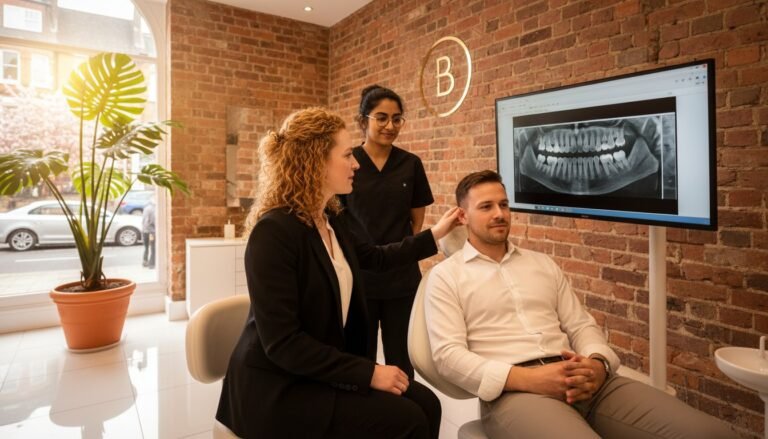

Facing the news that you need a dental crown can feel overwhelming. Perhaps a tooth is weak or broken, or maybe you’ve just completed root canal treatment and are wondering what comes next. It’s completely natural to feel uncertain and have questions about the procedure, the materials, and what to expect. You want a solution that not only fixes the problem but also gives you peace of mind.
We understand your concerns, and this guide is here to provide clear, reassuring answers. A dental crown is one of the most reliable ways to restore a tooth’s strength, shape, and function, acting as a protective, custom-made cap for the vulnerable tooth underneath. Think of it not as a complex treatment, but as a long-term investment in your comfort and oral health.
In the following sections, we will walk you through the entire process in a calm, simple way. We’ll explain why a crown is often essential, explore the different types available, and help you feel confident and fully prepared to protect and restore your smile for years to come.
Key Takeaways
- Understand how a custom-made ‘cap’ can restore a damaged or weakened tooth’s strength, function, and natural appearance.
- Discover why placing a dental crown is the essential final step after root canal treatment to protect your tooth for the long term.
- Learn about the different crown materials available, helping you make an informed choice that balances aesthetics, durability, and your personal needs.
- Feel reassured by learning about the gentle, two-visit procedure, which is carefully planned for your complete comfort from start to finish.
What is a Dental Crown and When is it Necessary?
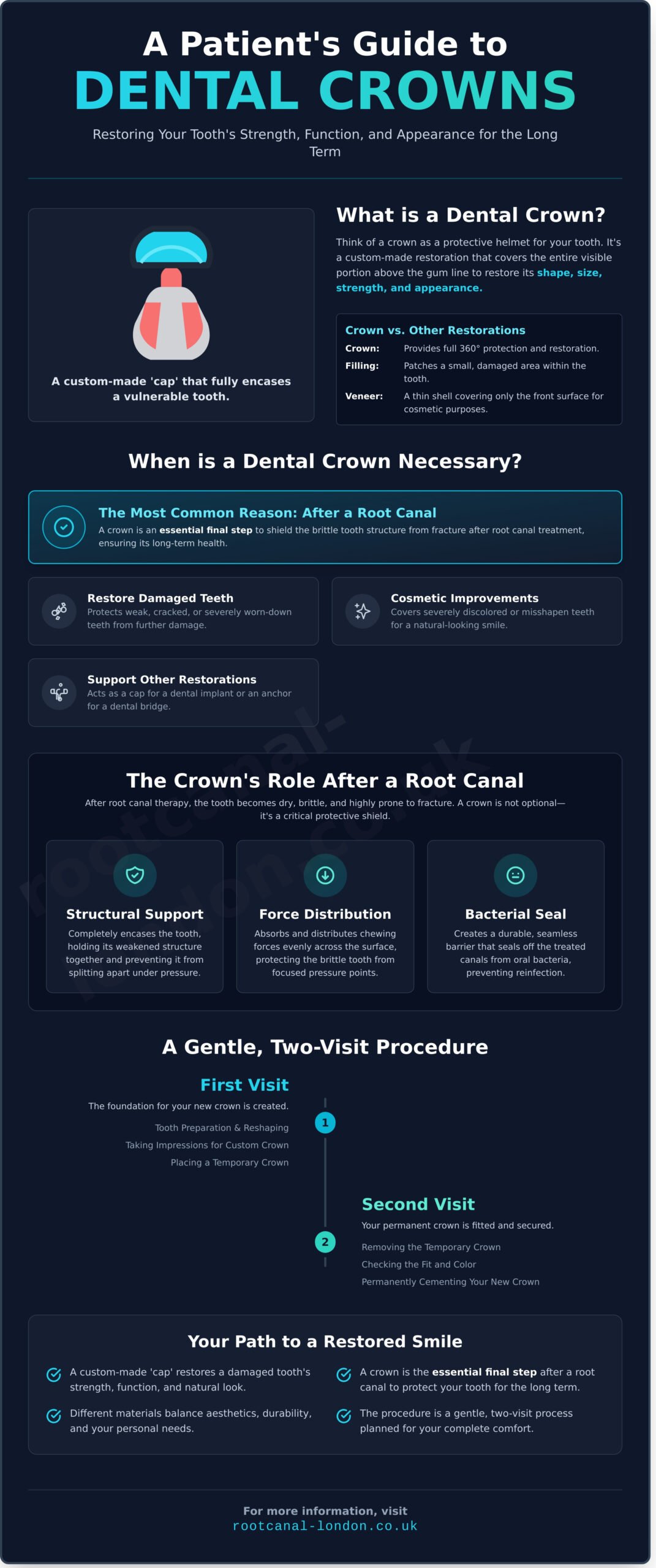
If your dentist has recommended a dental crown, it’s natural to have questions. We want you to feel calm and informed about your care. Put simply, a dental crown is a custom-made, tooth-shaped ‘cap’ that is carefully placed over a tooth. Its purpose is to restore the tooth’s original shape, size, and strength, while also improving its appearance. To better understand what is a dental crown, think of it as a protective helmet, encasing the entire visible portion of your tooth above the gum line.
Unlike a filling, which only patches a small area, or a veneer, which covers only the front surface for cosmetic reasons, a crown provides complete, 360-degree protection and restoration. This makes it an ideal solution for a number of common dental concerns.
Restoring a Severely Damaged Tooth
One of the primary reasons for a crown is to provide strength and stability to a compromised tooth. Your dentist may recommend one in several situations where a tooth is at risk, such as:
- To protect a weak tooth, often from advanced decay, and prevent it from breaking.
- To hold together the parts of a cracked tooth, stopping further damage.
- To restore a tooth that is already broken or has been severely worn down over time.
Cosmetic and Functional Improvements
Beyond structural repair, crowns play a vital role in both the function and aesthetics of your smile. They are an incredibly versatile solution used for:
- Covering a misshapen or severely discoloured tooth that doesn’t respond to whitening.
- Providing a natural-looking replacement tooth by covering a dental implant.
- Acting as a secure anchor to support a dental bridge, which replaces missing teeth.
The Most Common Reason: After a Root Canal
Perhaps the most critical reason we place a crown is to protect a tooth following root canal treatment. After the delicate inner pulp has been treated, the tooth’s structure can become more brittle and prone to fracture. Placing a crown is not an optional extra; it is an essential final step to shield the tooth from the pressures of biting and chewing, ensuring it remains healthy for the long term. This crucial topic will be explored in greater detail next.
The Crucial Link: Why a Crown is Essential After a Root Canal
Choosing to have root canal treatment is a significant step towards saving a natural tooth and ending painful symptoms. It’s an investment in your oral health. However, the treatment itself is only the first step. To ensure the long-term success and strength of your tooth, a permanent restoration is needed. This is where a dental crown becomes not just a recommendation, but an essential part of your care.
Think of it this way: the root canal therapy cleans and saves the inside of the tooth, but the crown protects the outside. Simply placing a filling is often not enough to provide the structural support the tooth now desperately needs for everyday function.
Understanding a Post-Root Canal Tooth
After a root canal, the internal structure of your tooth is fundamentally changed. The living pulp, which contains nerves and a blood supply, has been removed. While this stops the pain and infection, it also means the tooth no longer receives hydration and nutrients from within. Over time, this causes the tooth to become dry and brittle, much like an old, dry tree branch. This brittleness makes it significantly more vulnerable to cracking or fracturing under the normal pressures of biting and chewing.
How a Crown Acts as a Protective Shield
A dental crown acts like a custom-fitted helmet for your vulnerable tooth. The entire dental crown procedure is designed to create this protective shield, which provides several critical benefits:
- Structural Support: It completely encases the treated tooth, holding it together and preventing the weakened structure from splitting apart.
- Force Distribution: The crown absorbs and distributes chewing forces evenly across the surface, protecting the brittle tooth underneath from concentrated pressure points that could cause a fracture.
- Bacterial Seal: It creates a durable, seamless barrier that seals off the treated canals from bacteria in your mouth, preventing any chance of reinfection and ensuring the success of your endodontic treatment.
By completing your treatment with a crown, you give your tooth the best possible chance for a long and healthy life. At Bespoke Dental Fulham, we ensure your tooth is properly protected after treatment.
Types of Dental Crowns: Choosing the Right Material for You
Modern dentistry offers several excellent materials for a dental crown, and the best choice for you involves a careful balance of strength, natural appearance, and your budget. We understand this can feel like a complex decision, but there is no need to worry. Your dentist will provide a caring and professional recommendation based on the tooth’s location, its function, and your specific needs. The material needed to protect a molar, for instance, must be incredibly strong, particularly when a crown is essential after a root canal to prevent fracture.
Here is a simple guide to help you understand your options.
Porcelain and All-Ceramic Crowns (Zirconia)
These are often the top choice when aesthetics are the primary concern. They offer the most natural and seamless colour matching, making them perfect for restoring front teeth. Being completely metal-free, they are also biocompatible and an ideal solution if you have metal allergies. Modern materials like Zirconia provide this beautiful appearance along with outstanding strength, making them durable enough even for your hardworking molars.
- Best for: Front teeth and achieving the most natural look.
- Key benefit: Excellent aesthetics and biocompatibility.
Porcelain-Fused-to-Metal (PFM) Crowns
PFM crowns have been a trusted and reliable choice in dentistry for decades, offering a great balance of strength and aesthetics. They are built with a strong metal alloy core for durability, which is then covered with a layer of tooth-coloured porcelain. One consideration is that over a long period, a thin, dark line from the underlying metal may become visible at the gumline, especially if your gums begin to recede.
- Best for: A strong and aesthetic solution for any tooth.
- Key benefit: A time-tested combination of strength and good appearance.
Metal and Gold Alloy Crowns
For unparalleled strength and longevity, nothing surpasses a metal alloy crown. These crowns are exceptionally resistant to chipping, breaking, and wear, often lasting for decades with proper care. A significant advantage is that they require less of your natural tooth structure to be removed for fitting. Due to their distinct metallic colour, they are an ideal and highly practical choice for back molars that are not visible when you smile.
- Best for: Back molars that endure heavy chewing forces.
- Key benefit: Maximum durability and minimal tooth preparation.
The Dental Crown Procedure: A Gentle, Two-Visit Process
Understanding what to expect can significantly ease any anxiety about dental treatment. At our practice, we ensure the process of receiving a dental crown is as calm and comfortable as possible. The entire procedure is typically completed over two appointments, with your well-being as our highest priority at every stage.
We are dedicated to providing a stress-free experience, ensuring you feel informed and cared for from your first visit to the final placement of your beautiful new crown.
Your First Visit: Preparation and Impressions
This initial appointment is all about preparing your tooth and creating a perfect blueprint for your permanent crown. We take every measure to ensure you are completely comfortable throughout.
- Numbing for Your Comfort: First, we apply a local anaesthetic to completely numb the tooth and the surrounding gum tissue. You won’t feel any discomfort during the preparation; your peace of mind is paramount.
- Gentle Reshaping: To make space for the new crown to fit perfectly, we carefully and gently reshape the outer surface of your tooth.
- Precise Impressions: We then take a highly accurate impression, or mould, of the prepared tooth. This can be done with a traditional putty or a modern digital scanner, providing our skilled lab technicians with the exact specifications they need.
- Fitting a Temporary Crown: Before you leave, we will fit a custom-made temporary crown. This protects your prepared tooth, reduces sensitivity, and allows you to eat and smile confidently while your permanent restoration is being crafted.
Your Second Visit: Fitting Your Permanent Crown
About two weeks later, you’ll return for your final appointment. This is the exciting part where we place your permanent crown and restore your tooth to its full strength and function.
- Final Checks: We will gently remove the temporary crown and clean your tooth. Your new, permanent crown is then placed over the tooth to meticulously check its fit, shape, and colour. We ensure it blends seamlessly with your natural teeth.
- Perfecting Your Bite: We’ll ask you to bite together to check that your bite is comfortable and balanced. Any minor adjustments needed for a perfect fit will be made right then and there.
- Securing Your New Tooth: Once you are completely happy with the look and feel, we will permanently cement your new crown in place, leaving you with a strong, durable, and natural-looking restoration.
If you have a damaged or weakened tooth, our compassionate team is here to help. Contact us today to learn more about how we can restore your smile with our expert, caring approach.
Caring for Your New Crown: Aftercare and Longevity
Receiving a new dental crown is a significant step towards restoring your tooth’s function and appearance. With the right care, this durable restoration can protect your smile for many years. While crowns are made from robust materials, it’s important to remember that the underlying tooth and surrounding gums still require excellent oral hygiene to prevent decay or gum disease.
A well-maintained crown can last anywhere from 5 to 15 years, and sometimes even longer. Following a few simple aftercare steps will help you maximise its lifespan and keep your smile healthy and comfortable.
Daily Care and Maintenance
Treat your crowned tooth just as you would your natural teeth. Consistent, gentle care is the key to preventing problems at the gumline, where the crown meets the tooth. We recommend:
- Brushing thoroughly twice a day with a fluoride toothpaste, paying special attention to the gumline around the crown.
- Flossing daily to remove plaque from the tricky space between the crown and adjacent teeth.
- When flossing, slide the floss out sideways from the space rather than pulling it straight up. This helps protect the seal of the crown and prevents it from being accidentally dislodged.
Things to Avoid
To protect your new dental crown from damage, it’s wise to be mindful of certain habits and foods. Protecting your restoration helps avoid the need for emergency repairs. Try to avoid:
- Chewing on very hard objects like ice, pen tips, or hard sweets, as this can cause the porcelain to chip or crack.
- Excessively sticky or chewy foods (like toffees or hard caramels) which can potentially pull at or loosen the crown.
- If you grind or clench your teeth (bruxism), especially at night, speak to us about a custom-made nightguard. This simple device provides a protective cushion to prevent damage to your crown and natural teeth.
When to Contact Your Dentist
Your comfort and peace of mind are our priority. While problems are uncommon, it’s important to know when to seek professional advice. Please get in touch with us if you experience any of the following:
- Your crown feels loose, has chipped, or has fallen off completely.
- Your bite feels ‘off’, uneven, or uncomfortable when you close your mouth.
- You notice new sensitivity, a dull ache, or sharp pain around the crowned tooth.
Prompt attention can often prevent a small issue from becoming a more complex problem. Our team is here to help with any concerns. We are committed to ensuring your restoration feels comfortable and secure.
Your Path to a Restored and Confident Smile
Ultimately, a crown is a proven and effective solution for protecting a compromised tooth, restoring its function, and completing essential treatments like a root canal. The process is reassuringly straightforward, and modern materials ensure a result that is both durable and natural-looking. You can feel confident that this treatment is a positive investment in your long-term oral health.
Choosing the right team is crucial for a calm and successful experience. At Bespoke Dental Fulham, our specialist Endodontist-led care is focused on preserving your natural teeth. We use state-of-the-art technology to provide a precise and comfortable dental crown procedure, ensuring your peace of mind is our top priority. If you are considering this restorative treatment, we invite you to reach out.
Need to discuss restoring a tooth? Contact our specialist team. We are here to guide you with compassionate, expert care every step of the way.
Frequently Asked Questions About Dental Crowns
Is getting a dental crown painful?
We understand this is a primary concern for many patients. The procedure itself is not painful. We use an effective local anaesthetic to completely numb the tooth and surrounding area, ensuring you are comfortable throughout the treatment. You may experience some mild sensitivity for a few days afterwards as the anaesthetic wears off, but this is temporary and can be managed easily with over-the-counter pain relief. Our priority is always your comfort and a stress-free experience.
How long does a dental crown last?
A well-maintained dental crown can last for many years, typically between 10 and 15, but sometimes even longer. Its lifespan depends on several factors, including the material used (such as porcelain or zirconia), your personal oral hygiene, and avoiding habits like teeth grinding or chewing very hard objects. Regular dental check-ups are essential to ensure your crown and the underlying tooth remain healthy and secure for the long term, giving you lasting peace of mind.
Can a tooth with a crown still get a cavity?
While the crown material itself cannot decay, the natural tooth underneath it can still be vulnerable to cavities. Decay most often occurs at the margin, which is the line where the crown meets your natural tooth. This makes excellent oral hygiene crucial. Thoroughly brushing twice a day and flossing daily, paying special attention to the gum line around the crowned tooth, will help prevent decay and keep your natural tooth structure healthy and strong for years to come.
What is the difference between a dental crown and a veneer?
The main difference lies in their purpose and how much of the tooth they cover. A dental crown is a full “cap” that encases the entire visible portion of a tooth. It is primarily a restorative treatment used to add strength and protection to a weak or broken tooth. In contrast, a veneer is a very thin shell, usually made of porcelain, that is bonded only to the front surface of a tooth to improve its cosmetic appearance, like its shape or colour.
How much does a dental crown cost in the UK?
The cost of a dental crown in the UK varies between NHS and private treatment. On the NHS, a crown falls under a set charge band. Privately, the cost typically ranges from approximately £600 to over £1,200 per tooth. This price depends on the material used (e.g., all-ceramic crowns are more expensive), the complexity of your case, and the location of the clinic. We always provide a clear, detailed treatment plan with all costs outlined upfront for full transparency.
What happens if my dental crown falls off?
If your crown falls off, please don’t panic. The first step is to contact your dentist immediately to schedule an appointment. Keep the crown in a safe, clean place and bring it with you. It is very important not to try and reattach it yourself with household glues. We will assess the crown and your tooth to determine why it came loose. In many cases, if the crown and tooth are undamaged, we can simply clean and re-cement it for you.